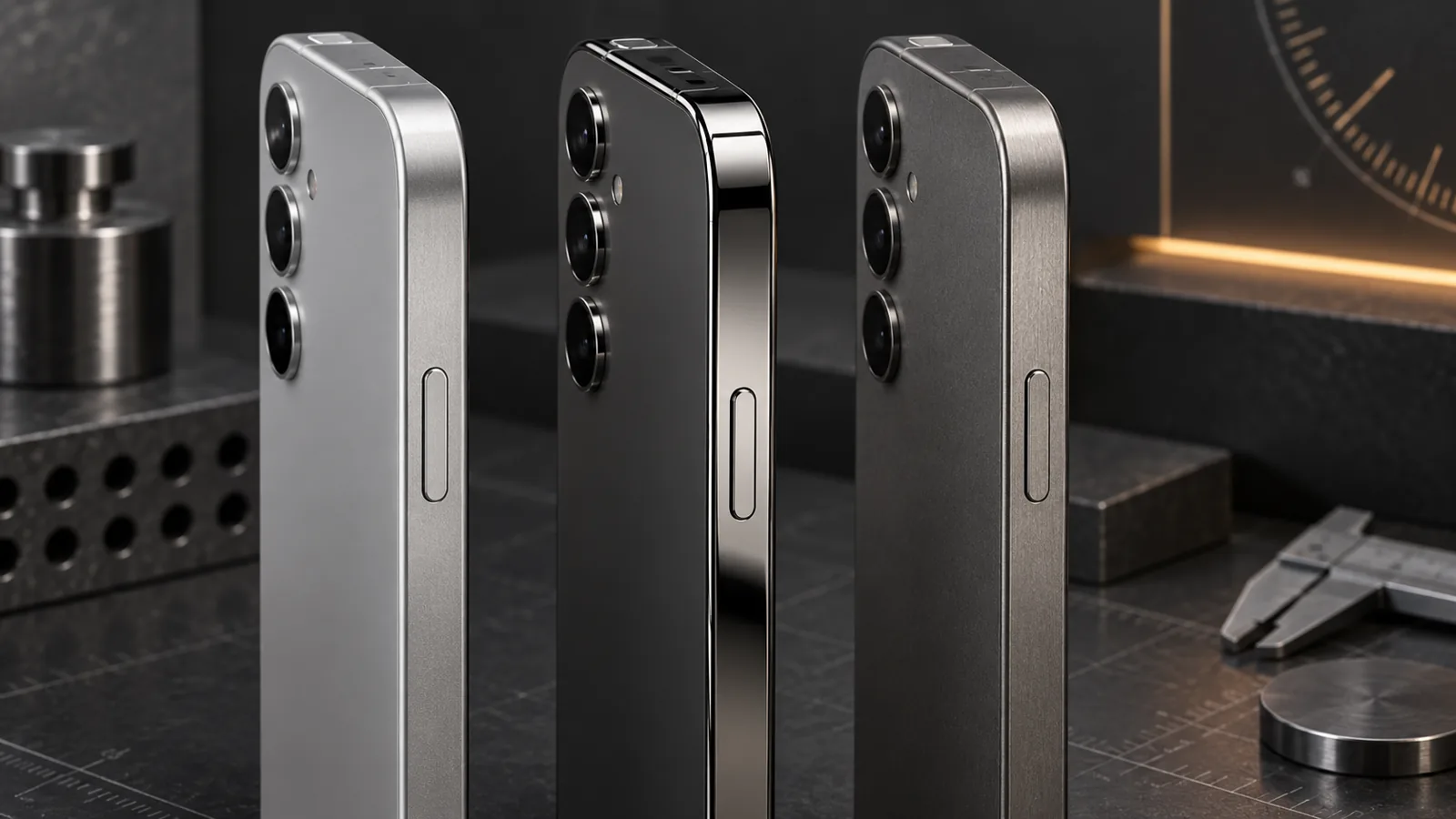
Titanium sounds premium. Stainless steel feels expensive. Aluminum is often dismissed as the cheaper option.
Those impressions are real, but they are not a reliable engineering ranking.
A phone frame does several jobs at once. It holds the display and back glass in alignment, carries impact loads, provides mounting points for internal components, contributes to antenna design and influences how heat reaches the outside world. It must also be manufacturable at enormous scale, accept a durable finish and remain comfortable in the hand.
No single metal wins every category. Aluminum is light and thermally conductive. Titanium provides high strength for its weight. Stainless steel is dense, rigid and visually distinctive. The result a buyer experiences depends on the alloy, thickness, geometry, internal substructure and surface treatment—not the marketing word printed on the product page.
This guide explains what each material actually changes, which claims are often overstated, and how to judge a phone built from a mixture of metals and glass.
The short answer
For most phones, aluminum is the best all-round engineering compromise. It keeps weight manageable, spreads heat efficiently, accepts anodized finishes and costs less to machine than titanium. Its disadvantages are lower strength at equal cross-section and a greater tendency to show dents or deformation when a design is too thin.
Titanium makes the strongest case when it replaces stainless steel. It can reduce the mass of a premium frame while retaining a stiff, corrosion-resistant outer structure. It is harder and more expensive to manufacture, conducts heat relatively poorly and may be used only as a bonded exterior rather than throughout the chassis.
Stainless steel delivers the heaviest premium feel. It can resist everyday deformation and polish to a mirror finish, but its high density is difficult to ignore in large phones. The glossy surface can also collect fingerprints and fine scratches.
The practical ranking is therefore:
| Priority | Best starting point | Main qualification |
|---|---|---|
| Low weight | Aluminum | Complete phone design still determines weight |
| Strength relative to weight | Titanium | Alloy, cross-section and bonded structure matter |
| Heat spreading | Aluminum | Internal cooling remains more important |
| Dense premium feel | Stainless steel | Adds substantial mass |
| Color variety | Anodized aluminum | Coatings and dyes age differently |
| Corrosion resistance | Titanium or stainless steel | Modern aluminum frames also use protective finishes |
| Value and manufacturability | Aluminum | Lower material cost does not mean poor construction |
First: a “titanium phone” is not necessarily solid titanium
Phone marketing compresses a complex enclosure into one material name. The phrase can describe an outer band, selected structural components or a layer bonded to another metal.
Apple’s iPhone 15 Pro is a useful documented example. Apple said its titanium bands were bonded to an internal structure made from recycled aluminum using a thermomechanical process and solid-state diffusion. Apple specifically credited the aluminum frame with assisting thermal dissipation and making the back glass easier to replace.
That mixed construction is logical. Titanium can provide the appearance, surface feel and exterior strength, while aluminum creates a lighter, more conductive internal path. But it also means simplistic arguments such as “titanium traps all the heat” or “the entire phone is aerospace titanium” miss how the product is actually assembled.
Before comparing materials, ask:
- Which part of the enclosure uses the advertised metal?
- Is it a full unibody, an exterior band or a thin layer joined to aluminum?
- What alloy and surface treatment are used?
- How thick is the structure at its weakest points?
- What material connects the processor and battery area to the frame?
Without those answers, material names describe ingredients rather than performance.
Material fundamentals that matter in a phone
Density affects weight—but does not determine it alone
Aluminum is the least dense of the three. Common titanium alloys are roughly 60% denser than aluminum, while common stainless steels are considerably denser again. This is why replacing a stainless-steel band with titanium can reduce weight even though titanium itself is not lighter than aluminum by volume.
Manufacturers can also exploit strength by changing wall thickness, geometry and internal reinforcement. A stronger material does not automatically create a lighter phone if the designer uses the saved structural margin for a larger battery, camera system or different shape.
Always compare the published weight of the finished devices. A material advantage that fails to reduce total weight may still help stiffness or packaging, but buyers should not invent a comfort benefit they cannot feel.
Strength is not the same as scratch resistance
Several properties are casually grouped together as “durability”:
- Yield strength: when permanent bending or denting begins.
- Tensile strength: how much pulling stress the material tolerates before failure.
- Hardness: resistance to indentation and some forms of surface wear.
- Toughness: ability to absorb energy before fracturing.
- Stiffness: how much the structure flexes under load.
- Coating adhesion: whether the visible finish chips, wears or changes color.
A phone can have a strong frame but a coating that scratches. It can resist bending while its glass cracks during a corner impact. It can look cosmetically damaged yet remain structurally sound.
This is why one key, coin or drop anecdote cannot establish a universal hierarchy. Independent tests must compare the exact phones, not bare samples of metal with different shapes and finishes.
Thermal conductivity affects the heat path
Aluminum moves heat far more readily than typical titanium alloys or austenitic stainless steel. This makes it useful for internal frames, heat spreaders and enclosures designed to distribute energy away from a concentrated processor area.
But “better heat dissipation” is easily misunderstood. A conductive enclosure may feel warmer because it moves heat to the surface efficiently. That can be evidence of successful heat spreading rather than worse cooling. Conversely, a cooler-feeling edge does not prove the processor is cooler; heat may remain concentrated internally and trigger throttling.
Real thermal performance depends on:
- chip power consumption;
- vapor-chamber or heat-pipe area;
- graphite and thermal-interface materials;
- connection between the heat spreader and enclosure;
- surface area and phone thickness;
- software power limits;
- ambient temperature and workload.
Judge cooling with sustained benchmark results, frame and back temperatures, battery temperature and recovery time—not the frame metal alone.
Aluminum phone frames: the practical all-rounder
Aluminum is common because it solves several problems efficiently. It is light, machinable, recyclable, thermally conductive and suitable for anodizing. Manufacturers can create matte surfaces and a wide range of colors without the fingerprint-heavy mirror finish associated with polished steel.
Advantages of aluminum
- Lowest material density of the three.
- Strong heat spreading relative to titanium and stainless steel.
- Efficient high-volume machining and forming.
- Anodized colors can become part of the oxide surface rather than a thick painted layer.
- Makes it easier to keep large phones reasonably light.
- Lower manufacturing cost can be spent elsewhere—or simply reduce price.
Aluminum disadvantages
- Lower strength than titanium or many steels at the same geometry.
- Thin edges can dent, gouge or deform after hard impacts.
- Anodized layers can reveal bright raw metal when deeply damaged.
- Threaded mounting points and small structural features require careful engineering.
- “Cheaper” material can reduce perceived luxury even when the technical decision is sensible.
Apple’s iPhone 17 Pro illustrates why a flagship manufacturer might return to aluminum. Apple describes its vapor chamber as laser-welded into a thermally conductive aluminum unibody. This integrates the frame into the cooling strategy instead of treating the exterior material as decoration.
That does not prove every aluminum phone cools well or survives drops. It demonstrates that aluminum can be a performance choice, not merely a cost reduction.
Titanium phone frames: excellent strength, complicated value
Titanium’s attraction is its combination of strength, corrosion resistance and lower density than steel. A matte titanium surface can also hide fingerprints better than polished stainless steel and create a distinctive premium texture.
Titanium advantages
- Excellent strength-to-weight potential.
- Substantially lighter than stainless steel for a comparable volume.
- Strong corrosion resistance.
- Premium matte or brushed finish.
- Useful for thin, highly loaded components and mixed-material structures.
Titanium disadvantages
- More expensive and difficult to machine at scale.
- Lower thermal conductivity than aluminum.
- Denser than aluminum, despite being described broadly as “lightweight.”
- Surface coatings can still scratch or discolor.
- The amount of titanium may be much smaller than marketing implies.
- Benefits shrink when the phone remains heavy or immediately enters a case.
The strongest consumer case for titanium is not “titanium is always better.” It is that titanium can provide a more comfortable alternative to a heavy steel enclosure while preserving a premium surface and sufficient structural strength.
The weaker case is paying a large premium when the device uses a thin outer band, weighs no less than an aluminum competitor and spends its entire life inside a thick protective case.
Stainless-steel phone frames: premium weight is still weight
Stainless steel became associated with premium phones because it can produce a glossy, jewelry-like edge while providing good strength and corrosion resistance. It feels dense and substantial—qualities many users interpret as expensive.
Stainless-steel advantages
- High strength and stiffness in appropriately designed frames.
- Strong corrosion resistance.
- Polishes to a visually striking mirror finish.
- Dense, substantial feel that some buyers prefer.
- Mature manufacturing and finishing processes.
Stainless-steel disadvantages
- Highest density of the three materials.
- Can make Pro Max-size phones tiring during long use.
- Polished finishes show fingerprints and fine scratches readily.
- Conducts heat less effectively than aluminum.
- Premium feel may be the only benefit a case-wearing owner notices.
Stainless steel is not obsolete. It remains defensible in smaller devices or where structural geometry and finish justify the mass. On a large phone with a substantial battery and camera island, however, every additional gram competes directly with hand comfort and drop energy.
Does titanium make a phone run hotter?
This question is too broad for a yes-or-no answer.
At the material level, aluminum is the better heat conductor. At the product level, many titanium phones contain aluminum internally, and their processors do not necessarily send heat directly through the titanium band. A well-designed vapor chamber in an aluminum chassis can outperform a poorly designed aluminum phone; a titanium exterior over a competent internal heat spreader can also perform well.
Use four pieces of evidence:
- Sustained performance after 20–30 minutes, not a single benchmark run.
- Surface-temperature maps showing where heat reaches the hand.
- Battery temperature during charging and demanding workloads.
- Performance recovery after the workload ends.
If a reviewer only reports that one frame “felt hotter,” the observation is useful but incomplete. Faster heat transfer can increase surface sensation while lowering an internal hotspot.
Which material survives drops best?
No responsible answer can rank complete phones using material names alone.
During a drop, the enclosure, glass, adhesive, corner radius, internal mid-frame and impact surface interact. A rigid frame may preserve shape but send more load into the glass. A softer metal may dent and absorb energy while keeping the phone functional. A heavier phone carries more kinetic energy at the same fall speed.
Independent model-specific tests should examine:
- corner and face-down impacts;
- permanent frame deformation;
- separation between frame and glass;
- camera and button function after impact;
- water-resistance integrity after damage;
- repair cost, not only cosmetic appearance.
Do not translate “titanium is strong” into “the screen cannot crack.” The glass is still glass, and many expensive failures happen away from the metal band.
Scratches, fingerprints and aging
Aluminum
Anodized aluminum typically resists fingerprints well and supports varied colors. Deep scratches can cut through the anodized surface and expose bright metal, making damage visually obvious on dark finishes.
Titanium
Matte or brushed titanium can disguise fingerprints and fine wear. Color is often produced through coating or surface processes whose durability varies. A scratch may affect the visible finish without meaningfully weakening the frame.
Stainless steel
Polished steel quickly collects fingerprints and micro-scratches. It may still look premium when clean, and some bare finishes can be polished, but coated colored versions complicate refinishing.
Buyers who care about cosmetic aging should search for six- and twelve-month owner photos of the exact color. Launch-day product shots reveal almost nothing about coating wear.
Repairability and ownership cost
Frame material influences repair indirectly. Machining difficulty, bonding method and whether the enclosure is integrated with internal components can affect the price of replacing a damaged chassis.
More important questions include:
- Can the back glass be replaced separately?
- Does a bent frame require a complete rear-system replacement?
- Are buttons, ports and camera mounts transferred during repair?
- Will opening the phone compromise water resistance?
- How much does the manufacturer charge outside warranty?
Apple explicitly linked the iPhone 15 Pro’s aluminum substructure to easier back-glass replacement. That is a good reminder that the material hidden inside the phone can matter more to repair than the metal buyers touch.
A frame that survives longer but costs dramatically more to replace is not automatically the lower-risk ownership choice. Durability and repairability should be evaluated together.
Does the material matter if you use a case?
A case does not make the frame irrelevant. The enclosure still carries structural loads, transfers heat and determines the bare weight. But it can erase much of the surface feel, fingerprint behavior, color and perceived luxury used to justify a premium material.
Case users should prioritize:
- Complete device weight.
- Cooling performance with the case installed.
- Repair cost after a severe impact.
- Button and port alignment.
- Whether the case traps grit against a coated frame.
If two phones perform similarly and both remain cased, paying substantially more for titanium becomes harder to justify.
Real iPhone case studies
| Model generation | Documented construction | What it demonstrates |
|---|---|---|
| iPhone 14 Pro | Stainless-steel exterior frame | Premium appearance accompanied by substantial weight |
| iPhone 15 Pro | Titanium band bonded to aluminum substructure | “Titanium” can be a deliberate mixed-material design |
| iPhone 17 Pro | Aluminum unibody with integrated vapor chamber | Aluminum can support flagship cooling and packaging |
| iPhone Air | Polished titanium frame | Titanium remains useful where thinness and structure are central |
These examples do not create a universal winner. Apple changed materials as the internal architecture and product goals changed. That is precisely why buyers should evaluate the engineering outcome instead of assuming the newest or most expensive metal must be superior.
For the upcoming generation, FlawCheck will update this guide only after Apple publishes the enclosure construction. Our iPhone 18 Pro early assessment deliberately treats unannounced material claims as provisional. Existing owners can use the iPhone 18 Pro vs iPhone 17 Pro comparison to separate a meaningful design change from upgrade anxiety.
Which material should you choose?
Choose aluminum when:
- Low weight and heat spreading matter.
- You want more color choices and a matte finish.
- The phone has strong independent durability results.
- You prefer value over a luxury material label.
Choose titanium when:
- It meaningfully reduces weight relative to a steel predecessor.
- The complete phone uses a credible mixed-material structure.
- You value a matte premium finish and corrosion resistance.
- The price premium is modest or accompanied by other useful upgrades.
Choose stainless steel when:
- You actively prefer a dense, jewelry-like feel.
- The phone is small enough that the added weight remains comfortable.
- You accept fingerprints and cosmetic micro-scratches.
- Model-specific durability and repair costs are favorable.
Ignore the material label when:
- The manufacturer does not explain which components use the metal.
- The phone remains too heavy for you.
- No independent thermal or durability testing exists.
- A protective case covers the finish permanently.
- The material is being used to distract from battery, camera, storage or repair compromises.
What to check during the next flagship launch
When Apple, Samsung, Xiaomi, Oppo, Huawei or another manufacturer announces a new enclosure, use this checklist:
- Is the material claim official or still a rumor?
- Is the full frame made from it, or only an exterior layer?
- Did finished-device weight increase or decrease?
- Is there a new vapor chamber or internal heat spreader?
- Does the manufacturer publish repair prices and construction details?
- Do independent sustained tests show better thermal behavior?
- Are early scratches cosmetic coating damage or structural damage?
- Does the design survive controlled drops without glass separation or frame deformation?
- Does the material improve the product, or mainly support a higher price?
This framework will be applied to FlawCheck’s iPhone 18 launch coverage after official specifications appear. The same framework also works for titanium hinges, mixed-metal foldables and future Android flagships. Our first-generation foldable iPhone risk analysis explains why hinge construction and repairability deserve more attention than a premium frame label.
Final verdict
There is no universally best phone-frame metal.
Aluminum is the rational default: light, conductive, manufacturable and capable of supporting flagship designs. Titanium is the specialist premium option: strongest when it replaces heavier steel or enables a genuinely better structure. Stainless steel is the tactile luxury choice: strong and attractive, but increasingly difficult to justify on already large and heavy phones.
The biggest mistake is comparing isolated material properties and assuming they predict the finished phone. A well-engineered aluminum enclosure can outperform a poorly integrated titanium one. A titanium band bonded to aluminum can combine advantages. A strong steel frame can still surround fragile, expensive glass.
Choose the phone whose complete weight, thermal performance, durability evidence and repair cost fit your ownership—not the one with the most impressive metal in its advertisement.
Sources and methodology
- Apple: iPhone 15 Pro titanium bands and aluminum substructure
- Apple: iPhone 17 Pro aluminum unibody and vapor chamber
- Apple: iPhone Air titanium construction
- Outokumpu: how stainless-steel thermal properties vary by grade
Read the FlawCheck editorial methodology for our evidence hierarchy and correction process.
Editorial disclosure: FlawCheck did not perform laboratory tensile, thermal or drop testing for this guide. Material behavior is described as an engineering tendency; product recommendations require evidence from the exact finished device.



