Post-launch evidence notice: Both iPhone 18 Pro models are official. FlawCheck has not independently tested retail battery life, sustained thermals or long-session ergonomics, so neither phone receives a numerical score here.
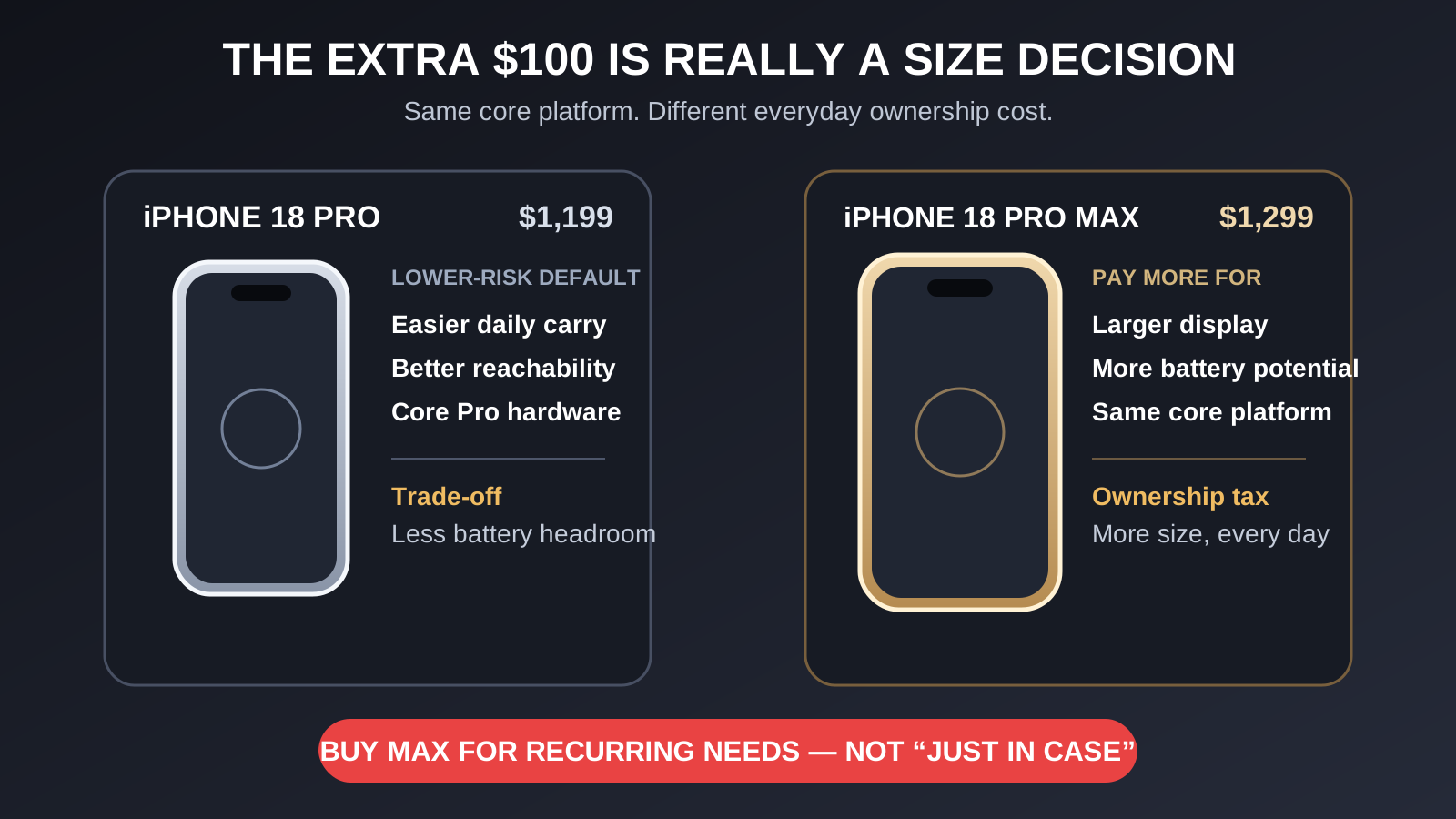
Apple’s new Pro models start at $1,199 and $1,299 in the US. Both use A20 Pro, Apple’s C2 modem and the new 48MP variable-aperture main camera. That makes this less a contest between a good phone and a better phone than a choice between two ownership compromises.
The downside-first question is simple: is maximum battery and a larger display worth paying $100 more and carrying the larger format every day?
Quick comparison
| Decision point | iPhone 18 Pro | iPhone 18 Pro Max | Downside-first read |
|---|---|---|---|
| US starting price | $1,199 | $1,299 | $100 is not the only cost difference |
| Chip | A20 Pro | A20 Pro | Do not buy Max for an assumed chip advantage |
| Modem | C2 | C2 | Cellular quality needs real-world testing on both |
| Main camera | 48MP variable aperture | 48MP variable aperture | Max is not automatically the camera winner |
| Main strength | Smaller Pro format | Maximum endurance and larger format | Choose by ownership priority |
| Main downside | Less battery headroom | Larger daily ergonomic burden | The trade-off persists every day |
| FlawCheck score | Not scored | Not scored | Evidence gate remains active |
The $100 question is really a size question
At flagship prices, $100 can look small enough to encourage an automatic step-up: if you are already spending $1,199, why not spend $1,299?
That framing hides the bigger difference. The Pro Max changes what you have to hold, pocket, mount and use one-handed every day. A buyer who dislikes large phones does not receive a bargain by paying only $100 more for a form factor they enjoy less.
Conversely, someone who spends hours navigating, recording video, gaming or working away from a charger may value the larger battery headroom far more than the price difference.
Battery is the best reason to choose Pro Max — measured with a trade-off
Because the core platform is shared, endurance is the most defensible reason to move up. A larger chassis can create more room for battery capacity and thermal management, and Apple positions the Pro Max as the maximum-endurance option.
But the magnitude matters. A modest improvement that only changes bedtime charge from 25% to 35% may not compensate for worse ergonomics. A repeatable improvement that removes an afternoon recharge during travel or field work could easily justify the Max.
Useful battery comparisons should include high brightness, 5G, navigation, camera use, standby drain and similar background settings. Video-loop claims alone are too narrow for a buying decision.
In Tom’s Guide’s retail review, the 18 Pro Max averaged 18:27 and the 18 Pro 16:17 in continuous 5G web browsing at 150 nits: a 2-hour, 10-minute advantage under one controlled workload. Apple’s video-playback estimates are different tests and should not be subtracted from these results.
Ergonomics are not a minor specification
Large-phone downsides compound over thousands of interactions. One-handed reach, pocket comfort, wrist fatigue, car mounts, running belts and prolonged camera use can all be affected by dimensions and weight distribution.
Try the phone with a case, not only bare on a display stand. A case adds bulk exactly where a borderline-large phone can become uncomfortable.
If you regularly use two hands and value screen area, the Pro Max downside may be negligible. If you already stretch to reach controls on large phones, no benchmark can remove that physical trade-off.
Apple lists 249 g for Pro Max and 211 g for Pro: 38 g of extra weight to carry. Both have the same A20 Pro and variable-aperture main-camera platform. Try each with a case before buying for battery alone.
Camera: do not pay for Max mythology
Both models use the 48MP variable-aperture main camera. Unless Apple documents another model-specific camera difference or independent testing reveals one, buyers should not assume the more expensive phone automatically produces better photos.
Variable aperture itself still needs real-world scrutiny. Look for matched tests involving moving subjects, low light, focus transitions, depth rendering, highlight control and long video recording. The feature is technically interesting, but the ownership value comes from better keeper rates and consistency, not the mechanism alone.
Performance: same chip, different measured stress stability
Both phones use A20 Pro, so ordinary peak performance should not be the reason to choose Max. The larger chassis could potentially affect sustained thermals, but that requires measurement.
A meaningful comparison should run long gaming, export or camera workloads and record performance over time, surface temperature and battery consumption. If the larger phone sustains more performance but also becomes less comfortable to hold, that is another trade rather than a universal win.
In Tom’s Guide’s retail review, Pro Max scored 79.4% stability and Pro 62.8% in a repeated 3DMark stress test. That is a model-specific result from one test; it does not establish everyday speed, gaming temperatures or equal performance across all software versions.
The Apple A-series guide’s sustained-performance section keeps Pro and Pro Max measurements separate and explains why stress stability cannot stand in for absolute sustained output. Sharing A20 Pro is not enough to transfer one model’s result to the other.
C2 modem: neither model gets a free pass
Both phones use Apple’s C2 modem. Reception, handoffs and efficiency depend on carrier, bands, congestion and geography, so neither model should be declared superior from launch specifications.
Buyers with weak-signal problems should pay particular attention to battery drain during poor reception. Cellular efficiency can matter more to all-day endurance than a laboratory Wi-Fi test suggests.
The hidden cost of choosing Max “just in case”
Buying more phone than you need creates its own ownership tax. You pay more upfront, potentially buy larger accessories, carry the bigger device and accept the ergonomic cost even on days when you never use the extra battery reserve.
The Pro Max premium makes sense when its advantages are recurring. It makes less sense as insurance against a hypothetical future need.
Who should buy iPhone 18 Pro?
Choose the smaller Pro when you want the current A20 Pro/C2/camera platform but value portability, reachability and lower physical burden. It is the safer default for buyers who do not already know they want the largest iPhone format.
Who should buy iPhone 18 Pro Max?
Choose Pro Max when long mixed-use endurance and the larger display directly support how you use the phone: travel, navigation, field work, video, gaming or frequent days away from charging.
The key phrase is directly support. Do not buy Max merely because it is positioned above Pro.
Verdict
For many buyers, iPhone 18 Pro is the lower-risk default because it retains the core Pro platform without automatically accepting the largest chassis. Choose iPhone 18 Pro Max only when the larger format and independently verified battery advantage are worth carrying every day.
If you already own last year’s model, read iPhone 18 Pro vs iPhone 17 Pro or iPhone 18 Pro Max vs iPhone 17 Pro Max. Our iPhone 18 Pro downside review tracks the evidence gaps that remain after launch. If you are still deciding whether to replace an older phone at all, start with the iPhone 18 upgrade guide before choosing a size.
First-week buyer evidence: September 25, 2026
Tom’s Guide’s retail review measured 18:27 (18 Pro Max), 16:17 (18 Pro), 17:54 (17 Pro Max) and 15:21 (17 Pro) in continuous 5G web browsing at 150 nits. These are one publication’s controlled measurements, not FlawCheck testing or a promise of personal battery life. 9to5Mac’s first-person one-week account describes one 18 Pro owner’s favorable daily battery and camera experience after switching from iPhone Air; it does not prove a universal owner consensus. 9to5Mac’s reproduced Face ID report documents a freeze/restart after failed Face ID on both Pro models, reproduced by its staff on 18 Pro, with a software fix reported as pending on September 23. The number of affected devices is unknown. Check the current iOS release before treating an old report as an ongoing defect.
Sources and disclosure
Launch specifications and US pricing were checked against Apple’s September 9, 2026 Newsroom announcement. FlawCheck has not independently tested retail units, so real-world battery, thermal, camera and ergonomic conclusions remain evidence-gated.