Post-launch evidence notice: The iPhone 18 Pro and Pro Max are official. FlawCheck has not independently tested the new retail hardware, so this guide separates confirmed launch specifications from ownership outcomes that still require measurement.
Apple’s September launch changed the upgrade question. The iPhone 18 Pro and Pro Max are official at $1,199 and $1,299 in the US, while Apple did not launch a base iPhone 18 at this event. Buyers should therefore avoid treating “iPhone 18” as one conventional four-model upgrade cycle.
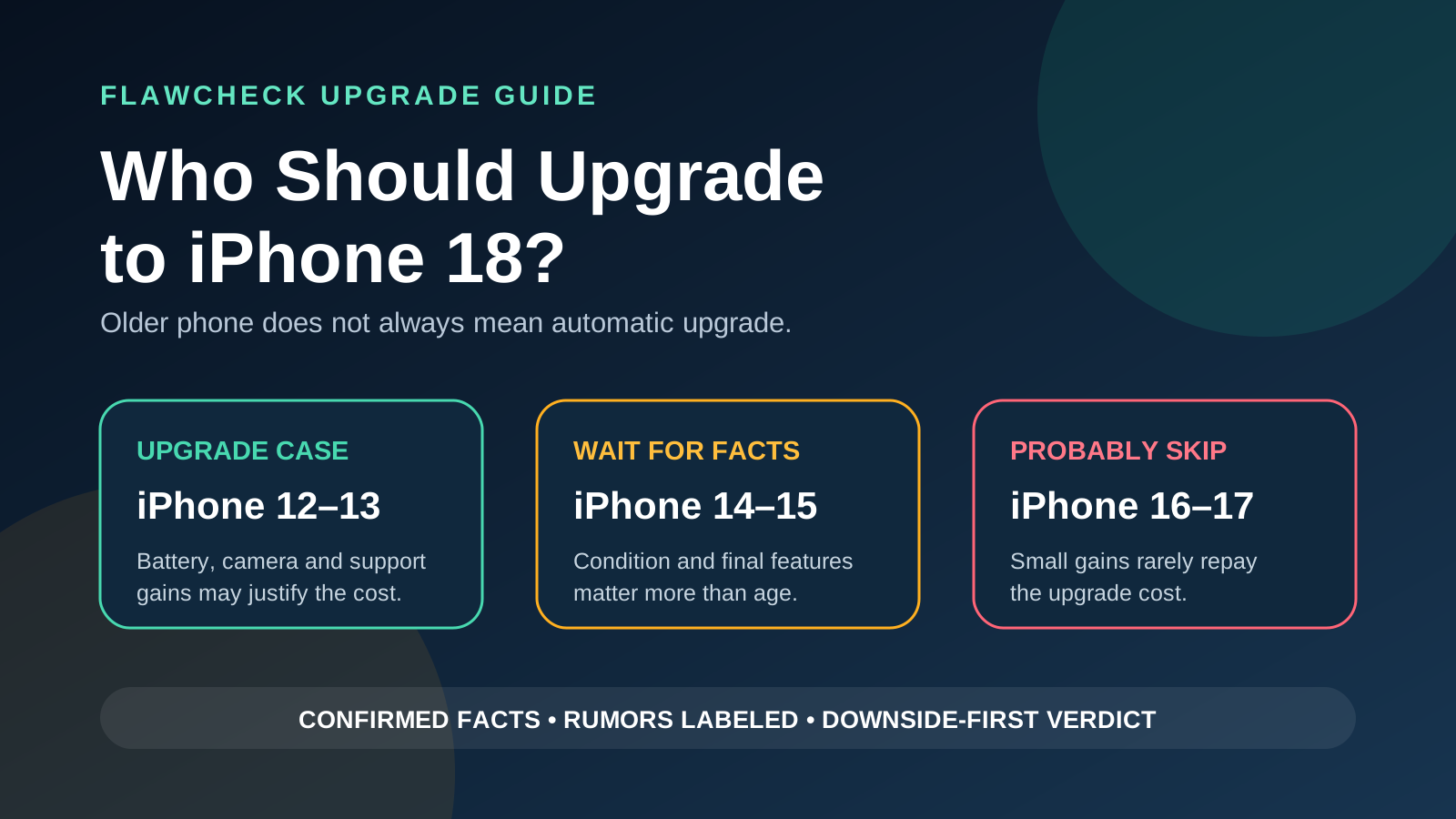
The downside-first rule remains the same: upgrade because the new phone fixes a real limitation, not because the calendar changed.
Downside-first upgrade map
| Your current phone | Default FlawCheck position | What could change it |
|---|---|---|
| iPhone 17 Pro / Pro Max | Keep it for now | Large measured gain in a problem you actually have |
| iPhone 16 Pro generation | Usually wait for evidence | Battery health, camera need or strong trade-in economics |
| iPhone 15 Pro generation | Compare condition and cumulative gains | Aging battery, storage pressure or meaningful workflow gains |
| iPhone 14 generation | Upgrade case becomes stronger | Condition plus several generations of accumulated improvements |
| iPhone 13 or older | Strong cumulative case | Budget, software support, battery and repair economics |
| Buyer waiting for base iPhone 18 | Do not substitute Pro by default | Buy Pro only if you actually need Pro-tier capabilities |
The biggest launch trap: spending $1,199 because the base model did not arrive
The absence of a base iPhone 18 from this launch does not make the 18 Pro a better value. It changes what is available, not what you need.
If your budget was aimed at the mainstream iPhone tier, moving to a $1,199 Pro because it is the newest device can convert launch urgency into several hundred dollars of unnecessary spending. A working current phone has option value: it lets you wait for the mainstream lineup, discounts, independent tests and early software issues to settle.
This is especially important for buyers who mostly message, browse, stream, navigate and take ordinary photos. Those workloads do not automatically require Pro-tier hardware.
What iPhone 18 Pro actually changes
Confirmed post-launch changes include A20 Pro on a 2nm process, a 48MP variable-aperture main camera, a smaller and more capable Dynamic Island, next-generation vapor-chamber cooling and Apple’s C2 modem.
Those changes are substantial engineering work. But buying decisions depend on outcomes rather than component names:
- How much longer does the battery last in mixed use?
- Does sustained performance improve without uncomfortable heat?
- Does variable aperture increase keeper rate in difficult scenes?
- Does C2 improve weak-signal stability and efficiency on your carrier?
- Are any gains large enough to repay the net replacement cost?
Our iPhone 18 Pro downside review tracks those evidence gates directly.
iPhone 17 Pro and Pro Max: the default answer is keep
A one-generation upgrade has the weakest economics because the existing phone is still recent and its early depreciation has already been paid.
A20 Pro may be faster, but A19 Pro is unlikely to be the daily bottleneck for most owners. Variable aperture may improve difficult photography, but matched-scene tests are needed. C2 may improve connectivity, but modem behavior is highly dependent on carrier and location.
If the 17-series phone has healthy battery capacity, adequate storage and no recurring camera or signal problem, keeping it is the lower-risk decision.
Read iPhone 18 Pro vs iPhone 17 Pro or iPhone 18 Pro Max vs iPhone 17 Pro Max for the model-specific decision.
iPhone 16 Pro generation: one extra year helps, but evidence still matters
The upgrade case improves because you are spreading the original purchase over a longer period and accumulating two generations of changes. Even so, a healthy 16 Pro is still a powerful device.
Battery health can become the deciding factor. If the battery is degraded, compare service cost against the net cost of upgrading. Replacing the battery may extend useful life at a fraction of the cost of a new Pro.
Camera professionals, heavy gamers and users with persistent signal issues should pay more attention to independent A20 Pro, variable-aperture and C2 testing because their workloads are more likely to expose meaningful differences.
iPhone 15 Pro generation: cumulative gains start to matter
At roughly three generations, the decision becomes less about one headline feature and more about accumulated changes. Battery aging, storage pressure, camera improvements, modem evolution and sustained performance can combine into a noticeable ownership difference.
But condition still matters. A well-functioning 15 Pro with healthy battery capacity can remain cheaper to keep than replace. A damaged unit needing expensive repair shifts the economics toward upgrading.
This is the point where total ownership cost becomes more useful than a simple specification comparison.
iPhone 14 generation and older: strongest conventional upgrade case
Owners of older devices benefit from several generations of cumulative improvements rather than asking one new component to justify the whole purchase.
The relevant questions become:
- Is battery health poor enough to affect daily use?
- Is storage constantly full?
- Are important software or AI capabilities unavailable?
- Does the camera fail in situations you regularly shoot?
- Is repair cost becoming disproportionate to device value?
- Would a newer modem materially improve your connectivity?
The older the phone, the easier it is for several modest improvements to add up to a meaningful change. That still does not mean every owner should buy the most expensive model.
Upgrade by problem, not generation number
A defensible upgrade problem is something you can describe before looking at the new phone. Examples include:
- Battery no longer survives your normal day.
- Storage pressure repeatedly disrupts your workflow.
- Camera limitations cause missed shots you care about.
- Performance or heat limits a repeatable task.
- Connectivity fails in places you use regularly.
- Repair cost approaches the value of replacement.
- Software support or required features are no longer available.
If you cannot name the problem, the upgrade is primarily discretionary. That is fine, but it should not be disguised as a technical necessity.
Battery health versus buying a new phone
Battery degradation is one of the most common reasons an older iPhone feels worse. It is also one of the few major ownership problems that may be repairable without replacing the entire device.
Compare three numbers: battery service cost, realistic resale value after service and net cost of the new phone after trade-in. A cheap battery replacement that gives another year or two of useful life can beat a four-figure purchase economically.
Storage pressure is different from performance pressure
A phone can feel “old” because storage is full even when its processor remains fast. Before upgrading, check what is consuming storage and whether photos, downloads or offline media can be managed without changing devices.
If you repeatedly need more local capacity for professional video, games or offline work, moving to a higher storage tier can be a legitimate reason to replace. Just remember that storage upgrades raise the purchase price beyond the advertised starting figure.
Camera upgrades need a use case
Variable aperture is one of the most interesting iPhone 18 Pro changes, but a technically sophisticated camera feature can still be irrelevant to someone who mostly shoots daylight snapshots.
The strongest camera-upgrade cases involve repeated failure modes: motion blur indoors, difficult low light, focus inconsistency, professional video limitations or a focal-length need your current phone cannot satisfy.
Wait for matched scenes rather than judging from keynote samples or isolated social-media images.
C2 modem: location matters more than marketing
Cellular behavior is difficult to universalize. A modem can perform well on one carrier and offer little practical change on another because bands, congestion, handoffs and geography differ.
If signal quality is central to your upgrade, look for testing on your carrier and in similar conditions. Weak-signal battery drain is as important as peak download speed.
A first Tom’s Guide’s retail review measured 16:17 for 18 Pro, 18:27 for 18 Pro Max, 15:21 for 17 Pro and 17:54 for 17 Pro Max in continuous 5G web browsing at 150 nits. These gains strengthen the battery case for some buyers but do not settle mixed-use endurance or the cost of replacing a one-year-old phone.
Which iPhone 18 Pro size should you choose?
Because Pro and Pro Max share the core A20 Pro, C2 and variable-aperture platform, the choice should focus heavily on battery versus ergonomics.
Choose the smaller Pro when portability and reachability matter more. Choose Pro Max when maximum endurance and the larger display repeatedly support your work or travel. Do not spend another $100 simply because “Max” sounds more complete.
See iPhone 18 Pro vs iPhone 18 Pro Max for the full downside-first comparison.
Also considering Apple Watch Series 12?
Apple’s watch launch has a similar upgrade trap: new health sensing and faster charging do not automatically justify replacing a one-year-old device. Read Apple Watch Series 12 vs Series 11 for the evidence-gated comparison.
What about iPhone Duo?
Duo is not simply the “best iPhone 18.” It is a $1,999 first-generation foldable with a different risk profile: hinge durability, flexible-display aging, repair cost, app continuity, dust exposure, battery packaging and ergonomics.
First-generation hardware deserves a higher evidence threshold because some failure modes emerge only after months of ownership. Buyers attracted by novelty should read our iPhone Duo first-generation risk analysis before comparing specifications. If camera changes are driving the upgrade, separate the iPhone 18 Pro variable-aperture evidence question from Apple’s processing look, which our overprocessed iPhone photo guide addresses independently.
If the decision includes Android, use our iPhone Duo vs Galaxy Z Fold7 vs Pixel 11 Pro Fold comparison to check switching costs, telephoto tradeoffs, cover-screen ergonomics and ecosystem fit.
A simple upgrade decision test
Before buying, answer these questions:
- What exact problem does my current phone have?
- Can repair or battery service solve it more cheaply?
- Which iPhone 18 Pro feature directly addresses that problem?
- Has that improvement been independently measured?
- What is my real net cost after tax, accessories and realistic resale?
- Would I still upgrade if the new model were not launching this week?
If the final answer is no, launch excitement may be doing more work than the product improvement.
Verdict
Recent Pro owners should usually keep their phone and wait for measured evidence. iPhone 15 Pro and older owners have progressively stronger cumulative upgrade cases, especially when battery health, condition or storage is deteriorating. Buyers waiting for a mainstream iPhone 18 should not let launch timing push them into a $1,199 Pro-tier purchase they did not originally need.
And buyers considering iPhone Duo should treat it as a separate first-generation foldable decision, not as an automatic step above Pro Max.
First-week buyer evidence: September 25, 2026
Tom’s Guide’s retail review measured 18:27 (18 Pro Max), 16:17 (18 Pro), 17:54 (17 Pro Max) and 15:21 (17 Pro) in continuous 5G web browsing at 150 nits. These are one publication’s controlled measurements, not FlawCheck testing or a promise of personal battery life. 9to5Mac’s first-person one-week account describes one 18 Pro owner’s favorable daily battery and camera experience after switching from iPhone Air; it does not prove a universal owner consensus. 9to5Mac’s reproduced Face ID report documents a freeze/restart after failed Face ID on both Pro models, reproduced by its staff on 18 Pro, with a software fix reported as pending on September 23. The number of affected devices is unknown. Check the current iOS release before treating an old report as an ongoing defect.
Sources and disclosure
The September 2026 lineup and iPhone 18 Pro pricing/specifications were checked against Apple’s official post-launch Newsroom material. FlawCheck has not independently tested the new retail hardware. Ownership conclusions that depend on battery, thermals, camera consistency or modem behavior remain evidence-gated.



