Launch-stage evidence notice: Apple has announced iPhone Duo, but retail availability does not begin until October 23, 2026. This comparison uses official specifications and product positioning. It does not treat launch claims as proof of long-term durability, battery life or app quality, so all three products remain not scored.
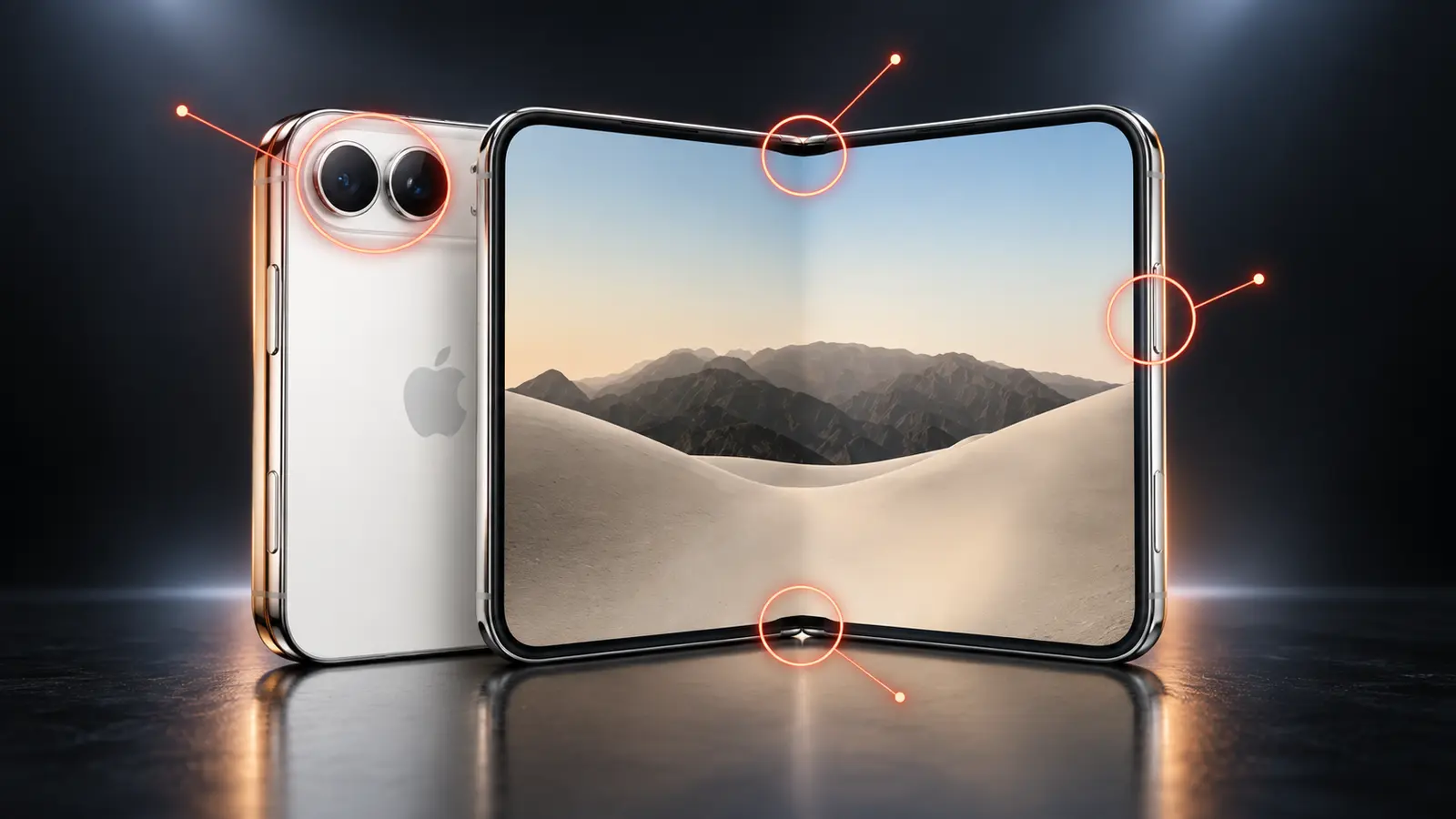
The most useful iPhone Duo vs Android foldables comparison after Apple’s September 2026 event is not “which spec sheet wins?” It is whether Apple’s first folding iPhone gives you enough daily value to justify a $1,999 purchase—and, for Android owners, the friction of changing ecosystems.
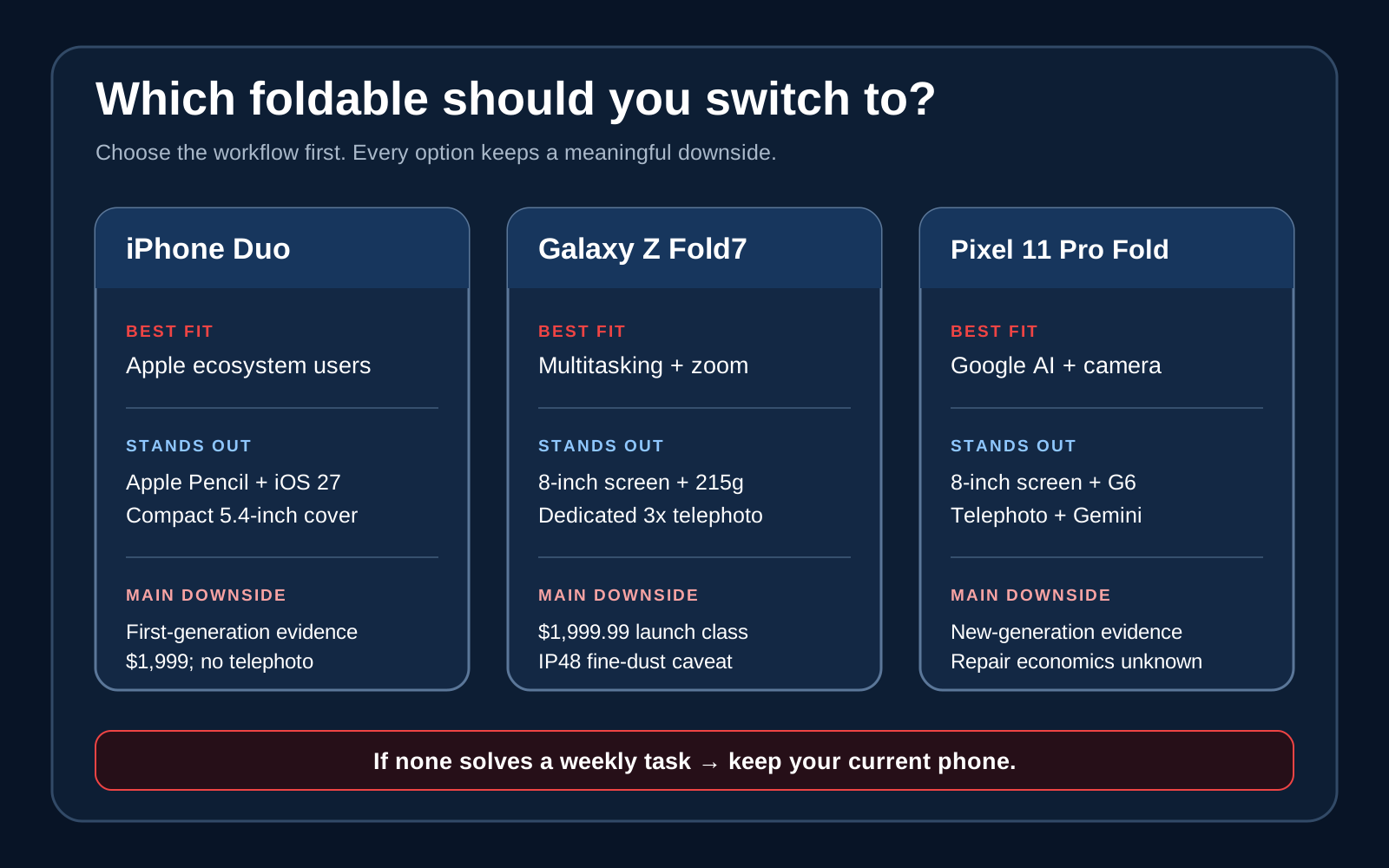
The short answer: iPhone Duo is compelling for committed Apple users, but it is not a universal upgrade over Galaxy Z Fold7 or Pixel 11 Pro Fold. Samsung offers a larger inner display, a lighter chassis and a dedicated telephoto. Google combines an 8-inch canvas with Tensor G6, Gemini features and a dedicated telephoto. Duo’s strongest case is continuity with iMessage, FaceTime, iCloud, AirDrop, Apple Watch and the rest of the Apple ecosystem.
Quick verdict: who should buy what?
| Buyer | Best fit | Why | Main reason to wait |
|---|---|---|---|
| Deep in Apple ecosystem | iPhone Duo | Lowest ecosystem friction; iOS 27 foldable features | First-generation display, hinge and repair evidence |
| Mobile multitasker | Galaxy Z Fold7 | 8-inch screen, mature Fold workflow, lighter body | $1,999.99 price and IP48 fine-dust caveat |
| Google AI and camera user | Pixel 11 Pro Fold | Tensor G6, Gemini, dedicated telephoto | New-model battery and long-term fold evidence |
| Camera zoom buyer | Galaxy Z Fold7 | Dedicated 3x telephoto and 200MP main camera | Foldable cameras still require matched testing |
| Risk-sensitive buyer | Keep current phone | Avoid launch tax and ecosystem migration | Reassess after retail tests and repair pricing |
iPhone Duo vs Galaxy Z Fold7 vs Pixel 11 Pro Fold specs
| Decision point | iPhone Duo | Galaxy Z Fold7 | Pixel 11 Pro Fold |
|---|---|---|---|
| Inner display | 7.6-inch OLED, 120Hz | 8-inch main display | 8-inch Super Actua Flex |
| Outer display | 5.4-inch OLED, 120Hz | 21:9 cover display | 6.5-inch Super Actua |
| Weight | 254g | 215g | Verify on regional spec page |
| Chip | A20 Pro | Snapdragon 8 Elite for Galaxy | Tensor G6 |
| Rear cameras | 48MP main + 48MP ultrawide; 2x crop | 200MP main + 12MP ultrawide + 10MP 3x telephoto | 48MP main + 10.5MP ultrawide + 10.8MP telephoto |
| Stylus | Apple Pencil (USB-C), later in 2026 | No stylus advantage assumed here | No stylus advantage assumed here |
| Water/dust claim | IP68 under Apple’s conditions | IP48 | Check regional official specifications |
| US starting price | $1,999 | $1,999.99 before trade-in | Check current Google Store configuration |
| Evidence status | Pre-retail | Shipping product | Newly announced/current generation |
Unknown or region-dependent values are deliberately left unfilled rather than inferred.
What is actually new about iPhone Duo?
1. It makes the Apple ecosystem fold
Duo’s conversion argument is not merely a 7.6-inch foldable iPhone display with Apple Pencil support. It is the ability to keep Apple-specific habits while gaining a book-style screen: iMessage and FaceTime continuity, iCloud Photos, AirDrop, Apple Pay, Apple Watch pairing and familiar iOS privacy controls.
For an iPhone owner who has avoided Android foldables because switching costs were too high, that is meaningful. For a Galaxy Fold owner already happy with Android, it is less persuasive. The hardware must solve a workflow problem; ecosystem familiarity alone is not worth $1,999.
2. iOS 27 starts with a focused multitasking model
Apple highlights Split View, two Safari windows and saved app pairs. That sounds simpler than Samsung’s mature multiwindow approach, which can be a benefit for users who want predictable two-app workflows rather than maximum window complexity.
But launch demos cannot establish third-party app quality. The decisive test is whether banking, editing, navigation, communication and work apps resize cleanly and preserve state between the 5.4-inch outer screen and the 7.6-inch inner screen.
3. The compact outer display is a deliberate trade
The long-tail question “iPhone Duo 5.4-inch outer display vs 6.5-inch foldable cover screen” matters more than it sounds. Duo should be easier to reach one-handed, while Samsung and Google provide more conventional phone-like cover screens.
The downside is frequency: if messages, maps or typing feel cramped, Duo owners may unfold for ordinary tasks. That can increase two-handed use and change real-world battery behavior. Try the outer screen with your most common tasks before buying.
4. Apple Pencil support creates a unique use case—and a new wear question
For notes, markup and sketching, iPhone Duo Apple Pencil support for the 7.6-inch screen could be the clearest productivity differentiator. Yet a flexible surface is not an iPad display. Buyers should wait for retail testing of writing feel, point pressure, coating wear and marks caused by debris between Pencil and panel.
Where Galaxy Z Fold7 still stands out
Samsung’s advantage is iteration. Galaxy Z Fold7 is not the first attempt in its line, and its software reflects years of foldable-specific development. Its 8-inch main display is larger than Duo’s 7.6-inch panel, while Samsung lists an 8.9mm folded thickness and a 215g weight—substantially lighter than Duo’s 254g.
The camera hardware is also more flexible on paper: a 200MP main camera, 12MP ultrawide and dedicated 10MP 3x telephoto. Duo offers a 48MP main, 48MP ultrawide and 2x optical-quality crop, but no dedicated telephoto. If concerts, travel details or portraits at longer focal lengths matter, Samsung has the clearer specification advantage.
The catch is not small. Galaxy Z Fold7 launched at $1,999.99 before trade-in, and its IP48 rating indicates water resistance plus protection against objects larger than 1mm—not a blanket promise against fine pocket dust. Mature does not mean risk-free.
Where Pixel 11 Pro Fold stands out
Google’s current foldable pairs 6.5-inch and 8-inch displays with Tensor G6 and 16GB RAM. Its triple camera includes a dedicated telephoto, and Google’s strongest appeal remains the combination of computational photography, Gemini features and a relatively direct version of Android.
For shoppers searching “best iPhone Duo alternative for Google Photos and Gemini users,” Pixel is the natural answer. It reduces the migration cost for people already centered on Gmail, Google Photos, Drive and Google Home.
Still, feature intelligence is not ownership evidence. Google’s 24-plus-hour battery language needs matched inner/outer-screen testing, and repair time, flexible-panel aging and resale value remain part of the decision.
Is iPhone Duo worth $1,999?
Use this value test:
| Question | A “yes” supports switching | A “no” supports waiting |
|---|---|---|
| Does a folding iPhone solve a task you do weekly? | Larger documents, paired apps, Pencil notes | Mostly novelty or occasional video |
| Are you already invested in Apple services and devices? | Migration friction stays low | Android workflow is already efficient |
| Can you tolerate launch-stage repair uncertainty? | Early-adopter risk is acceptable | You keep phones for years |
| Can Duo replace another device? | It may offset some tablet use | It adds cost without replacing anything |
| Do you need a telephoto camera? | 2x crop is sufficient | 3x/5x-style reach matters |
| Is $1,999 comfortable after coverage and accessories? | Total cost fits your budget | MSRP alone stretches it |
The conversion case is strongest when Duo replaces both a conventional iPhone and some compact-tablet tasks. It is weakest when it becomes an expensive second screen that still requires an iPad or laptop.
Should Android foldable users switch to iPhone Duo?
Usually, not at launch.
A Galaxy or Pixel foldable owner should switch only when at least two of these are true:
- You already use a Mac, iPad, Apple Watch or family iCloud plan.
- iMessage, FaceTime, AirDrop or Apple-only accessories remove recurring friction.
- Apple Pencil support solves a concrete mobile workflow.
- You prefer a compact cover screen and simpler two-app multitasking.
- You accept giving up Android customization, Google/Samsung continuity and potentially stronger zoom hardware.
Before moving, audit authenticator apps, WhatsApp history, paid apps, smartwatch compatibility, photo-library originals, smart-home routines, password managers, eSIM transfer and work-device policies. Those migration costs can matter more than benchmark differences.
Long-tail buying questions from the Apple event
Is iPhone Duo the best foldable phone for Apple ecosystem users?
It is the only direct answer for buyers who require iOS and Apple’s device continuity. “Best foldable” still requires retail evidence on crease aging, battery, apps and repair cost.
Is the iPhone Duo eSIM-only foldable easy to switch to?
Apple says Duo is eSIM-only worldwide. Confirm carrier support and the exact transfer process before wiping or trading in your current phone, especially when moving from Android or traveling across regions.
Should you preorder iPhone Duo on October 16?
Preordering makes sense only if form factor and Apple ecosystem access outweigh unknowns. Risk-sensitive buyers should wait past the October 23 release for matched battery, heat, crease, camera and app-continuity tests.
Is Apple Pencil on iPhone Duo worth switching from Galaxy Z Fold7?
Only if handwriting or markup is a frequent workflow. Pencil support is not automatically a productivity win, and the flexible display’s long-term response to repeated writing still needs evidence.
What are the first foldable iPhone buying risks?
The major evidence gaps are flexible-display aging, hinge contamination, mixed-screen endurance, app continuity, repair economics and resale. Read our detailed iPhone Duo first-generation risk analysis and focused iPhone Duo display-risk audit before buying.
Final recommendation
Buy iPhone Duo if you are already committed to Apple’s ecosystem, the folding screen replaces real iPad-like tasks, you value Pencil support and you knowingly accept first-generation uncertainty.
Choose Galaxy Z Fold7 if you want the more mature foldable workflow, larger main screen, lighter body and stronger zoom hardware without moving to iOS.
Choose Pixel 11 Pro Fold if Google’s AI, photo processing and services are your center of gravity. For buyers considering a China-first alternative, the Xiaomi 18 Fold review adds import, firmware, network and repair-access risks that a specification table misses; the Huawei Pura X View review shows how software compatibility can outweigh unusual hardware.
Keep your current phone if this is mainly launch-event excitement. The iPhone 18 upgrade guide can help identify whether you have a real upgrade problem; the iPhone 18 Pro vs Pro Max comparison is the lower-risk conventional-iPhone decision.
No product receives a score or universal winner yet. The honest answer to “should Android foldable users switch to iPhone Duo?” depends less on novelty than on ecosystem cost, camera needs and evidence that will only arrive after retail units ship.
Whichever model fits best on paper, the five-year foldable durability guide is the next check: it compares hinge-cycle claims with repair exposure, coverage cost, downtime and the phone’s declining value.
Sources and disclosure
Official product facts were checked against Apple’s iPhone Duo announcement, Apple’s iPhone Duo specifications, Samsung’s Galaxy Z Fold7 product page and Google’s Pixel 11 phone comparison. FlawCheck has not completed matched retail testing across these products. Manufacturer battery, durability and performance language is treated as a claim, not an independently verified outcome.