Xiaomi has launched the 18 Fold in mainland China, starting at 10,999 yuan. There is no broad global-release promise to make importing safe. Wait for retail-unit testing of the hinge, inner display, XRING O3 thermals, battery life and repair process before treating the launch presentation as a long-term ownership verdict.
The Xiaomi 18 Fold is trying to solve the most obvious problem with book-style foldables: many feel like two tall phones stacked together. Xiaomi calls its approach a “medium-fold solution.” Closed, it is closer to a passport-shaped device; open, its 7.58-inch screen can place three apps beside one another.
The headline engineering is impressive. Xiaomi says the phone weighs 219g and measures 5.02mm when unfolded, while the XRING O3 processor and CXMT LPDDR6 memory give it a distinctly Xiaomi-controlled platform. The company has also resisted the temptation to equip such a compact foldable with only one rear camera.
But this is also Xiaomi’s most expensive phone yet. Reuters reports prices from 10,999 to 14,999 yuan, and the initial launch is centered on China. A buyer is therefore paying flagship-laptop money for a new form factor, a new processor generation and the familiar mechanical risks of a folding display—all at once.
This is a research-based launch assessment, not a hands-on review. FlawCheck has not tested a retail unit, so the Xiaomi 18 Fold remains not scored. The purpose of this article is to identify what must be proven before the phone becomes a rational purchase.
Quick verdict: China buyers can wait; importers should wait longer
The Xiaomi 18 Fold is one of the most interesting foldable designs of 2026, but novelty is not the same as low risk.
For a buyer living near Xiaomi’s Chinese service network, waiting for several weeks of independent testing may be enough. The crucial evidence is repeatable: inner-display brightness and crease visibility, hinge behavior, sustained XRING O3 performance, real battery endurance, modem reception and the price of a screen assembly repair.
For an overseas buyer, the threshold should be higher. A reseller can ship hardware across a border; it cannot create local warranty eligibility, compatible carrier features, replacement parts or globally tuned software. Until Xiaomi announces an official release for your country, the safest answer is do not import it as your only phone.
1. The 10,999-yuan price magnifies every unproven detail
At 10,999 yuan, the base Xiaomi 18 Fold is not a speculative gadget bought with spare money. Reuters converts the starting price to roughly $1,540 at the launch-period exchange rate and reports a top configuration at 14,999 yuan, or about $2,100.
That price changes the standard of evidence. “It opens and looks thin” is not enough. Buyers need to know:
- whether the cover screen is comfortable for hundreds of daily interactions;
- whether the inner screen remains visually consistent around the crease;
- whether the hinge holds intermediate angles without wobble;
- how much a damaged display or hinge assembly costs;
- and whether resale buyers trust a first-year XRING-powered foldable.
The purchase cost is only the first layer. Add import tax, reseller margin, accidental-damage coverage, a case and potentially international shipping for service. One repair can erase any apparent saving against a foldable sold locally.
2. China-first availability is a practical disadvantage, not a footnote
Xiaomi’s official Chinese store lists the 18 Fold, while the launch reporting describes it as a mainland-China product. That does not prove the phone will never travel; it means global availability is not established today.
Imported phones can work perfectly for an enthusiast and still be poor recommendations for ordinary buyers. Before paying, verify the exact model’s:
- 4G and 5G bands used by your carrier;
- VoLTE, Wi-Fi calling and eSIM support;
- Google Play certification and banking-app behavior;
- Android Auto availability;
- language support and preinstalled regional services;
- push-notification reliability under Chinese firmware power management;
- bootloader-unlock and firmware-flashing policies;
- and warranty territory.
A list of radio bands is not the same as carrier certification. Likewise, installing Google apps does not prove that every notification, payment, passkey or work-profile requirement will behave like a global ROM.
3. Thinness creates questions about structure, cooling and repair
The 5.02mm unfolded thickness is a strong piece of engineering. It is also a constraint. A foldable must fit two frame halves, display layers, batteries, cameras, antennas, speakers and cooling hardware around a mechanical hinge.
Making each half thinner can improve comfort while reducing the physical space available for heat spreading and impact protection. That does not mean the Xiaomi 18 Fold is fragile or hot. It means Xiaomi’s thinness claim cannot answer those questions.
Independent testing should check:
- sustained gaming and camera recording rather than one benchmark run;
- surface temperature on both halves and around the hinge;
- frame flex when the device is open;
- drop behavior when the hinge edge takes the impact;
- and whether adhesive or display layers change after repeated heat cycles.
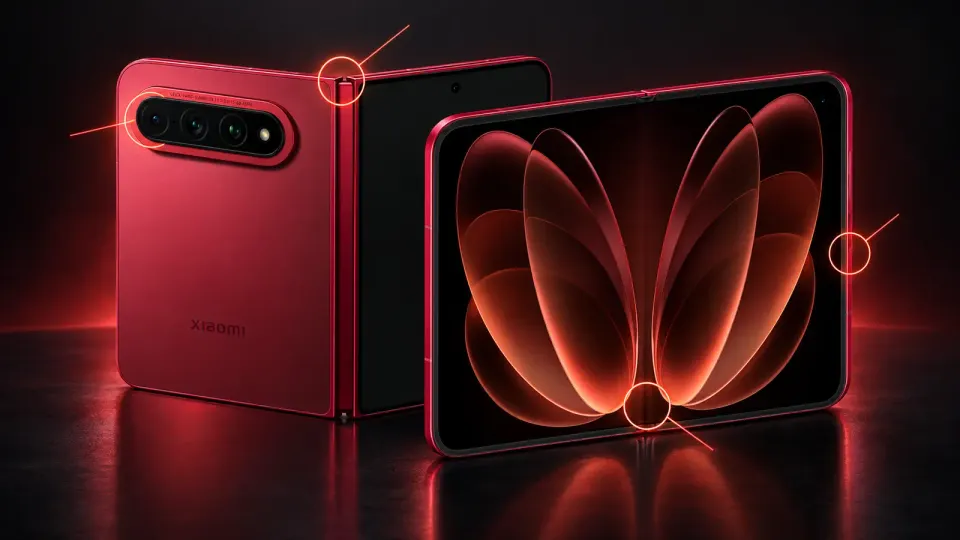
The generated hero image on this page is an editorial concept, not an official Xiaomi render and not evidence of a defect.
4. A flexible inner display remains a wear component
Every modern foldable combines a flexible OLED with protective films and supporting layers. The surface must bend, so it cannot behave exactly like the rigid cover glass on a conventional flagship.
The most visible issue is the crease, but it is not the only one. Buyers should watch for:
- reflections that make the fold line more obvious outdoors;
- touch or stylus inconsistency around the bending area;
- dents caused by fingernails or trapped debris;
- protector lifting at the edges;
- dead pixels or lines after impact;
- and layer separation after many heat and fold cycles.
Launch photos are controlled for angle and lighting. A useful review should show the display off, on a white page, on dark content and under a strong side light. It should also report whether the crease changes after hundreds or thousands of folds—not merely whether it looks good out of the box. Owners who see edge lift or a crease bubble should follow the foldable screen-protector peeling checklist rather than copying a removal method from another brand.
Our first-generation foldable phone risk guide explains why a less visible crease would not by itself settle the questions of pressure damage, debris, repair cost and long-term cycling.
5. The hinge adds a failure system that a slab phone does not have
A hinge must keep the two halves aligned, route display components safely and resist contamination while moving repeatedly. Thinness and low weight make that engineering problem harder, not irrelevant.
The questions Xiaomi’s specifications cannot answer include:
- Does the hinge become looser with use?
- Does it remain open at useful intermediate angles?
- Can fine debris migrate beneath the inner display?
- Is there a documented dust-resistance rating?
- What parts are replaced together if the hinge is damaged?
- Does service require wiping the phone or replacing both frame halves?
Water resistance, if specified for a market, should not be interpreted as proof against dust. Liquids and particles challenge seals in different ways. Owners who work around beaches, construction dust or metal fragments should be especially cautious until controlled tests and warranty language are available.
6. XRING O3 needs evidence beyond launch comparisons
The Xiaomi 18 Fold is the first flagship phone built around Xiaomi’s XRING O3. Vertical integration could eventually improve performance scheduling, camera processing and coordination with HyperOS. It also concentrates first-generation platform risk in the device.
At launch, Xiaomi compared responsiveness with Apple’s A19 Pro. That is a marketing comparison, not a substitute for matched testing. The important questions are:
- sustained CPU and GPU speed after 20–30 minutes;
- battery consumption under mixed mobile-data use;
- modem reception and handover behavior;
- GPS accuracy and standby drain;
- game-driver stability;
- camera processing time and heat;
- and how quickly Xiaomi fixes device-specific bugs.
Our Xiaomi XRING O3 analysis examines these risks in depth. A fast synthetic result can coexist with throttling, immature drivers or inefficient radio behavior. Judge the whole phone, not the process node or peak score.
7. Three apps side by side may be better in a demo than in your workflow
The wide 7.58-inch inner screen can support three applications side by side. That is the clearest reason to buy this form factor rather than a conventional phone.
But the physical ability to draw three windows does not guarantee useful productivity. Each column can become narrow, keyboard space consumes much of the display, and third-party applications may stretch or restart when the phone changes between cover and inner screens.
A practical test should include the exact combinations people use:
- browser, notes and messaging;
- email, calendar and a document;
- video call plus reference material;
- maps, translation and booking information;
- and drag-and-drop between supported apps.
The test should also track state continuity. If an app refreshes, loses a draft or forgets scroll position every time the phone is folded, the large screen creates friction instead of removing it.
8. Cameras and battery are still waiting for independent proof
Xiaomi equips the 18 Fold with three rear cameras, which is promising for a compact wide foldable. Yet the number of cameras does not establish motion capture, skin tone, zoom detail, autofocus reliability or video heat limits.
Foldables face a difficult camera trade-off. Large sensors and periscope modules need depth; thin bodies do not offer much of it. Computational processing can help, but it may also produce aggressive sharpening, inconsistent color between lenses or motion blur indoors.
Battery testing requires the same caution. A large inner OLED can be efficient when displaying static content and demanding during navigation, video calls or multi-window work. Reviewers should test both cover-screen-heavy and inner-screen-heavy days. A single “hours of use” figure hides the reason someone buys the phone.
FlawCheck will not assign camera, battery, performance or durability scores until independent retail-unit evidence is available.
What Xiaomi gets right
The downside-first view should not erase genuine progress:
- 219g is unusually light for a book-style foldable.
- The passport-like shape could be more comfortable than a tall, narrow Fold design.
- A 7.58-inch inner screen offers real workspace without approaching tablet bulk.
- Three-app multitasking is more ambitious than simply stretching one phone app.
- XRING O3 and LPDDR6 create potential for meaningful platform integration.
- Three rear cameras preserve more photographic flexibility than a minimalist dual-camera design.
These advantages make the 18 Fold worth testing. They do not make it safe to preorder or import without testing.
Marketing claim versus ownership reality
| Launch message | What buyers still need to establish |
|---|---|
| Passport-sized when closed | Cover-screen comfort, folded thickness and one-handed usability |
| Three apps side by side | App scaling, keyboard space, drag-and-drop and state continuity |
| 219g body | Hinge strength, frame flex and impact durability |
| 5.02mm when unfolded | Sustained cooling, battery volume and repair construction |
| XRING O3 flagship performance | Thermals, modem efficiency, drivers and retail-firmware stability |
| 10,999-yuan starting price | Insurance, depreciation, repair price and import overhead |
Who should buy—and who should avoid—the Xiaomi 18 Fold?
Consider it after independent testing if:
- you live in a supported Chinese market;
- you will use the wide screen and three-app layout every day;
- you can afford damage coverage and downtime;
- you have another phone available during repair;
- and you actively enjoy early hardware and software platforms.
Avoid it for now if:
- you need local warranty service outside China;
- you depend on perfect banking, work-profile, Android Auto or carrier compatibility;
- you mainly want a better camera or battery rather than a folding screen;
- you expect four or five years of proven durability;
- or one screen repair would make the purchase financially painful.
For a broader ownership framework, our long-term smartphone buying guide explains why update promises, battery replacement and repair access matter as much as launch specifications. To compare the foldable proposition rather than Xiaomi in isolation, use our iPhone Duo vs Galaxy Z Fold7 vs Pixel 11 Pro Fold guide as the mainstream-market reference point.
Final verdict
The Xiaomi 18 Fold is a convincing design experiment and a difficult purchase recommendation.
Its 219g weight, 5.02mm unfolded profile and three-app workspace attack real complaints about book-style foldables. Xiaomi is not merely copying a tall Fold template; it is betting that a wider, passport-shaped device is the more useful pocket computer.
The downside is the concentration of risk. Buyers are getting a flexible screen, mechanical hinge, unusual app canvas, new XRING O3 platform and China-first support model in a phone costing at least 10,999 yuan. Any one of those variables may work well. None should be treated as proven because the launch event looked polished.
FlawCheck recommendation: China-based enthusiasts should wait for independent retail reviews and initial owner evidence. Overseas buyers should wait for an official local release with documented bands, firmware, warranty and repair pricing. Until then, do not import the Xiaomi 18 Fold as your only essential phone.
Before treating a launch specification as long-term reassurance, apply our five-year foldable durability and repair-cost checklist, including regional screen pricing, protection-plan deductibles and repair access.
Sources and methodology
This assessment uses Xiaomi’s official Xiaomi 18 Fold product page, Xiaomi’s global launch coverage, and Reuters reporting from the September 7 launch. Sources were checked on September 8, 2026.
Confirmed launch facts are separated from testing requirements. Manufacturer weight, thickness, display and multitasking claims do not establish durability, battery life, image quality or sustained performance. Read our review methodology and editorial policy for how FlawCheck handles source-based launch coverage.
Editorial disclosure: FlawCheck has not handled or tested a retail Xiaomi 18 Fold. Xiaomi did not sponsor, review or approve this article. The hero is an editorial concept, not an official product image. Availability, firmware, network compatibility, warranty and pricing can vary by market.