The Galaxy S26 FE is not a bad phone. The problem is that $699.99 buys a familiar phone in a dangerous price bracket. You get a polished Samsung experience, IP68 protection and seven years of support, but also 8GB of RAM, mostly unchanged cameras and a 4,900mAh battery carried over from the S25 FE. Compare the actual price of the Galaxy S26 before choosing the FE.
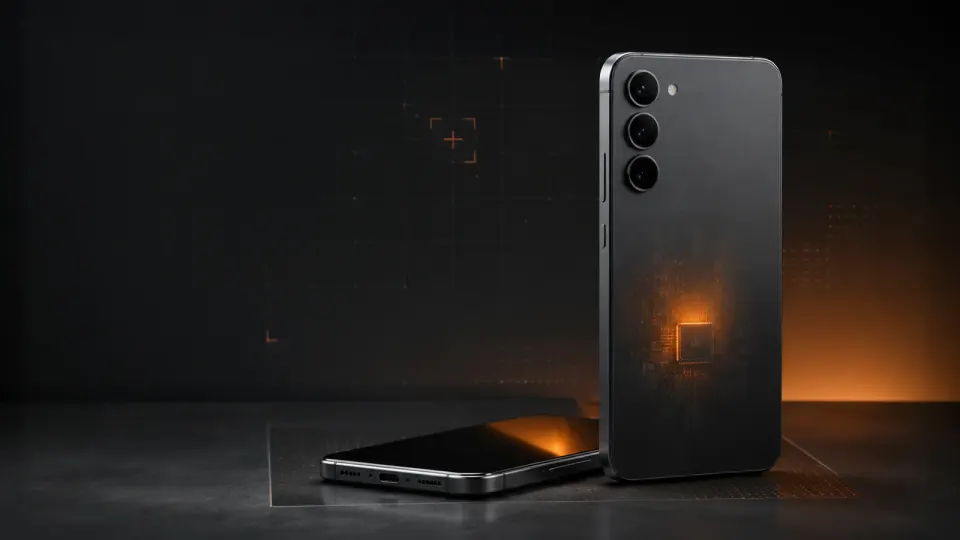
Image disclosure: The hero is a FlawCheck concept illustration created for this research-based review. It is not an official Samsung image or an exact representation of the retail Galaxy S26 FE.
The Samsung Galaxy S26 FE is a polished large-screen Samsung phone with a 120Hz AMOLED display, IP68 protection, 3x optical zoom, wireless charging and seven years of software support. The problem is value: at $699.99, it keeps 8GB RAM, a 4,900mAh battery and camera hardware that changes very little from the S25 FE.
Short answer: the Galaxy S26 FE is worth considering when a real discount puts it clearly below the regular Galaxy S26. At full price, compare the S26 first. Galaxy S25 FE owners should generally skip this generation, while Galaxy S21 FE and older owners have a stronger upgrade case.
This is a research-based review updated for retail availability, not a FlawCheck hands-on test. We have not independently measured battery life, camera quality, charging time, thermals, modem performance or sustained gaming speed. Because those ownership-critical results remain unverified, this review is not scored.
Is the Samsung Galaxy S26 FE worth buying?
At the full $699.99 price, the Galaxy S26 FE is difficult to recommend without comparison shopping. It becomes a sensible buy for Galaxy S21 FE and older Samsung owners when a real discount creates a clear gap below the Galaxy S26. Galaxy S25 FE owners should skip it: the unchanged 4,900mAh battery, 8GB RAM and familiar camera hardware do not justify a one-year replacement.
Buy it for the large AMOLED display, 3x optical zoom, IP68 protection, wireless charging and seven-year support promise. Avoid paying full price if the regular Galaxy S26 is within roughly $100–$150, or if you need proven sustained gaming performance and a major camera upgrade.
Galaxy S26 FE buying snapshot — not scored yet
| Area | What we know | What still needs evidence |
|---|---|---|
| Performance | Exynos 2500 is a newer 3nm platform than the S25 FE’s Exynos 2400 | Sustained gaming, thermals, modem efficiency and regional retail-unit behavior |
| Cameras | 50MP main, 12MP ultrawide and 8MP 3x telephoto provide a versatile layout | Matched image quality, moving subjects, low light, shutter behavior and video heat |
| Display | 6.7-inch 120Hz Dynamic AMOLED 2X with a 1,900-nit peak claim | Independent brightness, efficiency and outdoor-readability measurements |
| Battery and charging | 4,900mAh, 45W wired and 15W wireless charging | Mixed-use endurance, repeatable charging time and heat under charging |
| Build and support | IP68, aluminum, Victus+ and seven major Android upgrades are documented strengths | Long-term repair economics and real-world durability over years of ownership |
| Value | $699.99 list price places it between the A57 and regular S26 | The real recommendation changes with promotions, storage tier and checkout price |
FlawCheck will only assign a numeric score after the evidence required by the site’s scoring methodology is sufficient. Until then, the useful question is not whether the phone deserves a 7.x or 8.x—it is which compromises are already documented, and which important claims still need testing.
Eight Galaxy S26 FE disadvantages
1. The $699.99 price creates an awkward middle child
Samsung positions the FE as an affordable path into the Galaxy S family. The U.S. starting price is $699.99, compared with $649.99 for the S25 FE and $549.99 for the Galaxy A57 on Samsung’s own comparison table at launch.
The more dangerous comparison is the regular Galaxy S26. Its official list price is higher, but flagship phones rarely remain at launch pricing forever. Tom’s Guide noted during its early hands-on that Samsung’s 256GB Galaxy S26 was selling for the same price as the 256GB S26 FE.
That promotion may change. The buying rule does not: never choose the FE without checking the live price of the S26 first. A $200 difference can justify compromise. A $50–$100 difference often cannot. Our Galaxy S26 FE vs Galaxy S26 comparison compares equal storage, 8GB versus 12GB RAM, display behavior, cameras, battery and current pricing in detail. If the cheaper A-series model is the real alternative, our Galaxy S26 FE vs Galaxy A57 comparison tests whether optical zoom, performance and wireless charging justify the $150 premium. Existing FE owners should also read our year-over-year S26 FE versus S25 FE analysis before accepting a trade-in offer.
2. Eight gigabytes of RAM is difficult to celebrate in an AI phone
Every announced storage configuration uses 8GB of RAM. That is enough for ordinary apps, messaging, media and routine multitasking. It is less convincing as a seven-year foundation for a phone marketed around expanding Galaxy AI features.
AI processing does not automatically require enormous memory, and Samsung can optimize software around known hardware. Yet future operating systems, camera pipelines and on-device models are unlikely to become lighter. A 12GB option would have created more headroom for buyers expected to keep the phone through the early 2030s.
RAM Plus does not erase that hardware difference. Our guide to whether Samsung RAM Plus makes a phone faster explains why virtual memory may preserve some background state but cannot turn the FE’s 8GB of DRAM into the S26’s 12GB configuration. For a broader, conditional way to choose a memory tier, see our Android 6GB, 8GB and 12GB buying guide; the RAM gap alone is not a measured app-retention result for these two phones.
The base model also retains 128GB of storage. With no microSD expansion, buyers who record substantial video or keep devices for many years should price the 256GB model before judging value.
Buyers considering that base tier should also calculate how much storage must remain free for normal operation, because usable headroom for updates, games, and camera work is smaller than the headline 128GB.
3. “Pro-grade camera” depends more on software than new hardware
The rear system combines a 50MP main camera, 12MP ultrawide and 8MP 3x telephoto. It is flexible, and a real optical telephoto remains a useful advantage over many mid-range phones.
But compare the specification with Galaxy S25 FE:
| Camera | Galaxy S25 FE | Galaxy S26 FE |
|---|---|---|
| Main | 50MP | 50MP |
| Ultrawide | 12MP | 12MP |
| Telephoto | 8MP, 3x | 8MP, 3x |
| Front | 12MP | 12MP |
Samsung promotes an updated sensor, ProVisual processing, Nightography, My FanCam and horizontal stabilization. Those features may improve results. They do not turn familiar camera hardware into a proven generational leap.
Wait for matched retail-unit comparisons covering moving subjects, skin tones, low light, shutter lag and video heat before treating the camera as a major reason to upgrade.
4. The 8MP telephoto is useful—and still modest for $700
A dedicated 3x optical lens is better than relying entirely on digital crop. The compromise is its 8MP resolution, which leaves less room for cropping and detail recovery than higher-resolution telephoto sensors used by some competitors.
Samsung advertises digital zoom up to 30x. That figure describes reach, not guaranteed detail. The most useful range is likely to remain near the native 3x focal length, where optical stabilization and the dedicated lens can do their best work.
This camera broadens the phone’s versatility. It does not make the FE a camera flagship.
5. Exynos 2500 performance needs evidence, not a “flagship-level” label
The Exynos upgrade advice for the exact Galaxy model separates S26 FE from the folding Flip7 even though both have documented Exynos 2500 variants. The generation dataset contains no separate S26 FE measurement sample, so Flip7’s heat and stress observations do not establish this phone’s performance.
Samsung calls the 3nm Exynos 2500 a flagship-level chipset and highlights improved CPU, GPU and NPU performance. It should be faster than the Exynos 2400 used in Galaxy S25 FE.
What launch specifications cannot answer:
- How quickly performance drops during extended gaming.
- Whether 4K video recording creates thermal limits.
- How modem efficiency behaves on weak 5G networks.
- Whether camera and AI workloads meaningfully affect battery life.
- How retail firmware compares across regions.
None of those are reasons to declare Exynos 2500 bad. They are reasons not to treat a marketing tier as a test result. Our smartphone processor specs guide explains why 3nm and clock speed are incomplete, and our peak benchmark performance guide shows which workload, duration, battery and temperature details a credible sustained test must disclose. Buyers who prioritize gaming or sustained performance should wait for controlled comparisons with the regular Galaxy S26.
6. The battery is unchanged while rivals keep getting larger
Galaxy S26 FE uses a 4,900mAh typical battery, the same headline capacity as its predecessor. Samsung quotes up to 29 hours of video playback, but controlled video playback is not the same as a mixed day involving 5G, navigation, camera use, social apps and high brightness.
Capacity alone does not determine endurance. Display efficiency, modem behavior and the Exynos 2500 matter. Still, the unchanged battery reinforces the larger pattern: this is refinement, not a substantial hardware reset.
Owners planning to use the S26 FE across its long support window should also weigh 80% versus 100% charging. The lower limit may reduce time spent at a high state of charge, but it also removes usable runtime from a battery whose capacity has not increased.
If long ownership matters more than launch excitement, compare it with our five-year smartphone ownership guide. Seven years of software support is valuable only if the battery remains economical to replace. Before installing One UI 9 or another major release on the phone, our major Android update risk guide explains how to distinguish beta access from a stable OTA—and when to wait for model-specific evidence. For the broader Samsung lineup decision—A, FE, S, Ultra or Fold—use our Samsung Galaxy buying guide before committing to this model.
7. Forty-five-watt charging still requires another purchase
Samsung says a compatible 45W adapter can charge the phone to about 69% in around 30 minutes. The adapter is sold separately.
That creates two qualifications:
- Buyers coming from an older or lower-power charger may not receive the advertised speed without another purchase.
- Wireless charging remains limited to 15W, despite the phone’s near-premium price.
Wireless PowerShare is welcome for earbuds and watches, and 45W wired charging is an improvement over older Samsung models. Buyers moving from faster-charging Android brands may still find the experience conservative.
8. A 6.7-inch phone weighing 193g is not for compact-phone buyers
At 161.6 × 76.9mm, Galaxy S26 FE is a large phone. The 7.4mm thickness is impressively slim and the 193g weight is manageable, but one-handed reach remains the physical compromise of a 6.7-inch display.
The regular Galaxy S26 is the more logical Samsung option for buyers who prioritize pocketability and one-handed use. The FE makes sense when screen area matters more than compact dimensions—not merely because “Fan Edition” sounds like a smaller flagship.
What Samsung gets right
A downside-first review should not manufacture faults where the product has genuine strengths.
- IP68 protection: Samsung rates it for dust resistance and freshwater immersion under specified laboratory conditions. Water resistance is not permanent, but this is substantially more reassuring than splash-only protection. Read our IP68 versus water-damage warranty guide before treating the rating as a promise of covered liquid damage.
- Long support: Seven major Android upgrades and up to seven years of security patches make the FE suitable for longer ownership.
- Display quality: A 6.7-inch 120Hz Dynamic AMOLED 2X panel should provide a polished everyday experience.
- Complete feature set: Optical zoom, wireless charging, reverse wireless charging, aluminum construction and Samsung’s ecosystem are all present.
- Software: One UI 9 launches on Android 17, with Samsung’s mature multitasking, security and device-integration features.
The result is a well-rounded phone. FlawCheck’s objection is not capability—it is how much capability is genuinely new for the price.
Galaxy S26 FE vs Galaxy A57 vs Galaxy S26
| Buy this | When it makes sense | Main compromise |
|---|---|---|
| Galaxy A57 | You want a large Samsung phone for less | No dedicated telephoto and lower-tier performance |
| Galaxy S26 FE | You find a strong discount and want a large display plus 3x zoom | Familiar hardware and only 8GB RAM |
| Galaxy S26 | The price gap falls below roughly $100–$150 | Smaller display and higher list price |
These are not permanent price rules. Promotions, storage tiers, trade-ins and regional pricing can reverse the recommendation. Compare like-for-like storage and the final checkout price—not the largest advertised trade-in credit.
For another view of mainstream polish versus ownership compromises, see our Google Pixel 11 Pro downside review. If your budget is closer to the midrange, the Galaxy S26 FE vs Pixel 10a comparison isolates the camera, support and value tradeoffs without pretending that flagship positioning settles them. Buyers who value replaceable parts above camera and processor performance should also read the Fairphone Gen 6+ review.
Who should buy the Galaxy S26 FE?
Buy it if:
- You are upgrading from a Galaxy S21 FE or older device.
- Samsung offers a meaningful launch discount without requiring an unrealistic trade-in.
- You want IP68, wireless charging, optical zoom and long software support in one device.
- A large display matters more than compact dimensions.
Avoid it—or wait—if:
- You already own Galaxy S25 FE.
- A discounted Galaxy S26 is within roughly $100.
- You want 12GB RAM for long-term headroom.
- Gaming performance, camera consistency or battery endurance must be independently proven before purchase.
Final verdict
The Samsung Galaxy S26 FE is likely to be a dependable phone. That is a different claim from being a compelling launch-day purchase.
Its best qualities—display, IP68 protection, software support and ecosystem integration—are credible and useful. Its weaknesses are the $699.99 price, 8GB RAM, familiar camera system and lack of verified performance evidence. Samsung has refined the FE formula, but it has not clearly escaped the value trap between the cheaper Galaxy A series and discounted Galaxy S flagships.
At full price: compare before buying. At a substantial discount: the balance becomes much easier to recommend.
Sources and methodology
- Samsung Global Newsroom announcement and specifications
- Samsung US Galaxy S26 FE product page and comparison table
- Tom’s Guide Galaxy S26 FE hands-on review
- T3 Galaxy S26 FE early verdict
Read the FlawCheck editorial methodology for our evidence labels, provisional scoring rules and correction process.
Editorial note: This article is based on source research rather than physical testing by FlawCheck. A numeric score will only be considered after sufficient independent retail-unit evidence is available.
For context on Super AMOLED, LTPS and LTPO, read how phone display terminology works; the marketing name alone does not establish brightness, dimming comfort or refresh efficiency. Our OLED burn-in diagnostic guide explains how to assess a ghost image on any OLED phone; this is a general ownership check, not evidence of a Galaxy S26 FE defect.