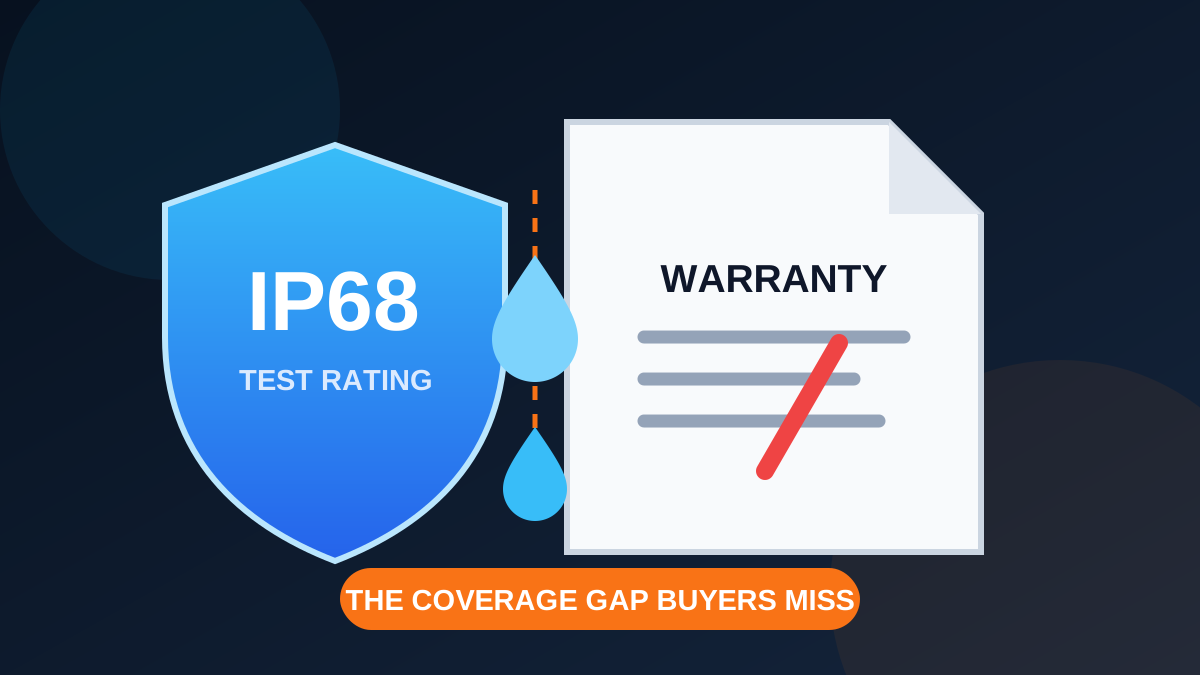
A phone can be advertised as IP68 water resistant and still be refused a free repair after liquid gets inside. That is not necessarily a contradiction. It is the protection gap buyers often discover only after an accident:
- the IP rating describes a controlled enclosure test;
- the limited warranty defines which failures the manufacturer will repair;
- an accidental-damage plan may provide separate coverage, usually with conditions and a service fee.
Treating those three things as interchangeable is the expensive mistake.
The downside in 20 seconds
IP68 is a safety margin, not water-damage insurance. It can make a spill, rain shower or brief accidental immersion less likely to destroy a new, undamaged phone. It does not prove the phone will survive every pool, beach, shower, jet of water or previous drop.
Before buying, ask three separate questions:
- What exact depth, duration and liquid did the manufacturer specify?
- What does the standard warranty say about liquid damage?
- If liquid damage is excluded, what does optional accidental-damage coverage cost and include?
If a salesperson or product page answers only the first question, you still do not know who pays when protection fails.
What IP68 actually proves
The IP code comes from IEC 60529, a standard for classifying how enclosures protect against solid objects and water. In “IP68,” the first digit concerns solid-particle protection and the second concerns water ingress.
| Code element | What it indicates | What it does not promise |
|---|---|---|
| IP | Ingress Protection classification | A repair or insurance contract |
| 6 | Dust-tight enclosure protection | Permanent sealing after years of use |
| 8 | Protection against continuous immersion under specified conditions | One universal depth for every IP68 phone |
The critical words are specified conditions. “8” is not shorthand for “six metres for 30 minutes” across the whole industry.
For example, Apple lists iPhone 16 Pro as IP68 under IEC 60529 with a laboratory claim of up to six metres for 30 minutes. Samsung support material commonly describes IP68 Galaxy testing in fresh water up to 1.5 metres for 30 minutes. Both can legitimately use IP68 while advertising different conditions.
That makes the exact model page more important than the badge alone.
The IEC explains the IP rating system, and its official IEC 60529 publication defines the classification framework.
Why an IP test and a warranty can reach different answers
An IP test asks a technical question: did a representative enclosure resist ingress under the test conditions?
A warranty asks a contractual question: is this individual failure covered, given its cause, the device condition, exclusions, evidence and local law?
Those questions can produce a frustrating but logically consistent outcome. A new phone design can pass its laboratory test, yet an individual device can later encounter:
- deeper or longer immersion;
- moving or pressurised water;
- salt, chlorine, soap, drinks or other contaminants;
- a bent frame or cracked glass after a drop;
- aged adhesive or seals;
- an earlier repair or disassembly;
- charging while moisture remains in the connector.
The rating does not reconstruct what happened to the damaged phone. The service process does.
The five protection gaps buyers should understand
1. Fresh laboratory water is not every real-world liquid
Water-resistance demonstrations usually rely on controlled fresh water. A swimming pool adds chlorine; the ocean adds salt and waves; a bathroom adds soap, steam and temperature changes; a spilled drink can leave sugar or acid behind.
Apple tells users to minimise exposure to soap, detergent, acids, perfume, insect repellent, lotions and high-pressure water. Samsung likewise warns that unclean liquids and forceful water can exceed stated protection.
A dramatic underwater video is therefore weaker buying evidence than the manufacturer’s handling instructions.
2. Static immersion is not pressure from movement
Depth is only one source of pressure. Diving, swimming strokes, a shower jet, a tap, a hose or a water sport can force liquid toward openings differently from a stationary laboratory immersion.
Apple explicitly advises against swimming, bathing, pressurised water and high-velocity activities with iPhone. That warning matters more than an informal claim that “IP68 means it can go underwater.”
3. The rating applies to a tested condition—not every future condition
Manufacturers repeatedly warn that water resistance is not permanent. Adhesives age. A drop can deform a frame without creating an obvious crack. Heat cycles and pocket wear can affect the seal system. A repair requires correct adhesive replacement and validation.
Apple says resistance may decrease through normal wear. Google says water resistance can be compromised by wear, repair, disassembly or damage. Samsung says resistance is not permanent and may diminish over time.
This is the biggest ownership downside: the badge printed at launch does not measure the seal condition three years later.
4. Passing an IP test does not write the warranty
Apple states that liquid damage is not covered by its one-year limited warranty, while noting that rights under consumer law may still apply. Google says accidental or external water damage is not covered and that liquid damage can make a device ineligible for in-warranty service.
Samsung’s position needs more nuance than a blanket claim. Its support pages emphasise model-specific fresh-water conditions, declining resistance and service-centre inspection. Samsung also describes cases where a service centre tests whether the water-resistance function itself is operating correctly. The outcome therefore depends on the cause, device, market and applicable terms.
The safe rule is universal: never infer warranty coverage from the IP rating. Read the warranty.
5. Optional coverage is a separate purchase with separate limits
Manufacturer care plans, carrier insurance and retailer policies may cover accidental liquid damage. That still does not make the standard warranty broader.
Check:
- whether liquid accidents are included;
- the service fee or deductible;
- the number of allowed claims;
- loss and theft exclusions;
- cosmetic-damage exclusions;
- replacement-device conditions;
- cancellation, transfer and regional rules.
Do not compare only the monthly premium. Compare the total cost of one likely claim.
Brand examples: the same badge, different paperwork
| Example | Resistance claim | Warranty reality to verify |
|---|---|---|
| Apple iPhone | Model-specific IP68 depth and duration; resistance is not permanent | Apple says liquid damage is outside its one-year limited warranty; consumer-law rights may still apply |
| Google Pixel | Model-specific rating; Google warns resistance can decline after wear, damage, repair or disassembly | Google says accidental or external water damage is not covered by the standard warranty |
| Samsung Galaxy | Model-specific conditions, commonly controlled fresh-water immersion; resistance can diminish | Service outcome depends on inspection, cause, regional warranty and any accidental-damage plan |
This table is not a substitute for the exact documents supplied with the device. Product families, carrier variants and national terms can differ.
For a live example, the Galaxy S26 FE downside review lists IP68 as a real strength—but the badge should still be read alongside Samsung’s stated conditions. The same check will matter when Apple publishes final specifications and service terms for the iPhone 18 Pro.
A better buying rule than “must have IP68”
IP68 remains valuable. A well-sealed phone has a better chance against ordinary accidents than a device with no tested resistance. The mistake is paying a premium while assuming the rating transfers financial risk to the manufacturer.
Use this buying rule:
Buy IP68 for accident resistance. Buy explicit accidental-damage coverage if you need financial protection from liquid damage.
Then judge the premium realistically. IP68 matters more if you work outdoors, live in a rainy climate, exercise with the phone or regularly use it near sinks. It matters less if the device is easy and economical to repair, remains mostly indoors, or the IP68 upgrade forces a large price jump.
Long support is also only one part of durable ownership. Our five-year phone buying guide combines software support with battery replacement, repair economics and physical durability.
Five checks before you buy
1. Save the exact product claim
Record the model number, IP rating, depth, duration, liquid type and footnotes. A family name is not enough; variants can differ.
2. Search the warranty for liquid terms
Look for “liquid,” “water,” “accidental damage,” “misuse,” “external causes” and “ingress.” Confirm whether the wording refers to the standard warranty or an optional plan.
3. Read the handling warnings
Note restrictions involving swimming, salt water, pools, showers, steam rooms, soap, high pressure, heat and wet charging. These warnings define the intended safety margin more honestly than the badge alone.
4. Price one accidental claim
Add the plan premium and service fee. Compare that with an independent repair or replacement. Coverage can be useful without being cheap.
5. Check repair and resealing policy
Ask whether an authorised repair includes a new seal and a post-repair pressure or ingress test. “Reassembled” and “restored to the original IP rating” are not automatically the same claim. If the repair is a battery swap, use our battery-replacement versus phone-upgrade test to count resealing, support life and the risk of a second aging component before approving the quote.
What to do when a phone gets wet
Follow the manufacturer’s instructions for the exact model. As a conservative first response:
- Remove it from the liquid and disconnect cables.
- Turn it off if it is safe and practical to do so.
- Wipe the exterior with a soft, lint-free cloth.
- Keep the charging port facing downward and allow airflow at room temperature.
- Do not charge until the device and connector are dry.
- Do not use external heat or insert objects into the port.
- Seek service if warnings persist, the liquid was corrosive, or the phone behaves abnormally.
Apple’s important handling information and Google’s water-damage guidance both prioritise drying and avoiding unsafe charging or heat. Manufacturer instructions take priority over internet folklore.
Buying a pre-owned iPhone adds a separate condition check. Our new, used and renewed iPhone buying guide explains how to assess seller commitments, repair information and purchase protection.
Final verdict
The biggest IP68 downside is not that the rating is meaningless. It is that the rating is easy to misunderstand.
IP68 provides useful evidence that a new enclosure passed controlled dust and immersion tests. It does not prove permanent protection, safe underwater use, survival in every liquid or free warranty repair after an incident.
A downside-first buyer separates the promise into three files: the IP claim, the warranty and the accidental-damage plan. If the second file excludes liquid and the third does not exist, assume the repair bill remains yours.
Sources and methodology
- IEC overview of IP ratings
- IEC 60529 standard publication
- Apple: liquid damage and warranty
- Apple: splash, water and dust resistance
- Apple: iPhone 16 Pro technical specifications
- Google Pixel: prevent water damage
- Google Pixel: warranty eligibility
- Samsung: Galaxy phone water resistance
- Samsung: IP68 care guidance
Read the FlawCheck editorial methodology for evidence labels, source standards and corrections.
Editorial note: This is a research-based buying guide, not a destructive water-ingress test. Warranty and coverage decisions are made under the applicable terms and local law.



