Evidence notice: This is a research-based comparison, not a matched hands-on test. Confirmed specifications and US launch prices come from Samsung and were checked on September 1, 2026. Any statement about real-world speed, battery life, image quality or thermals is marked as provisional until controlled testing compares retail units under the same conditions.
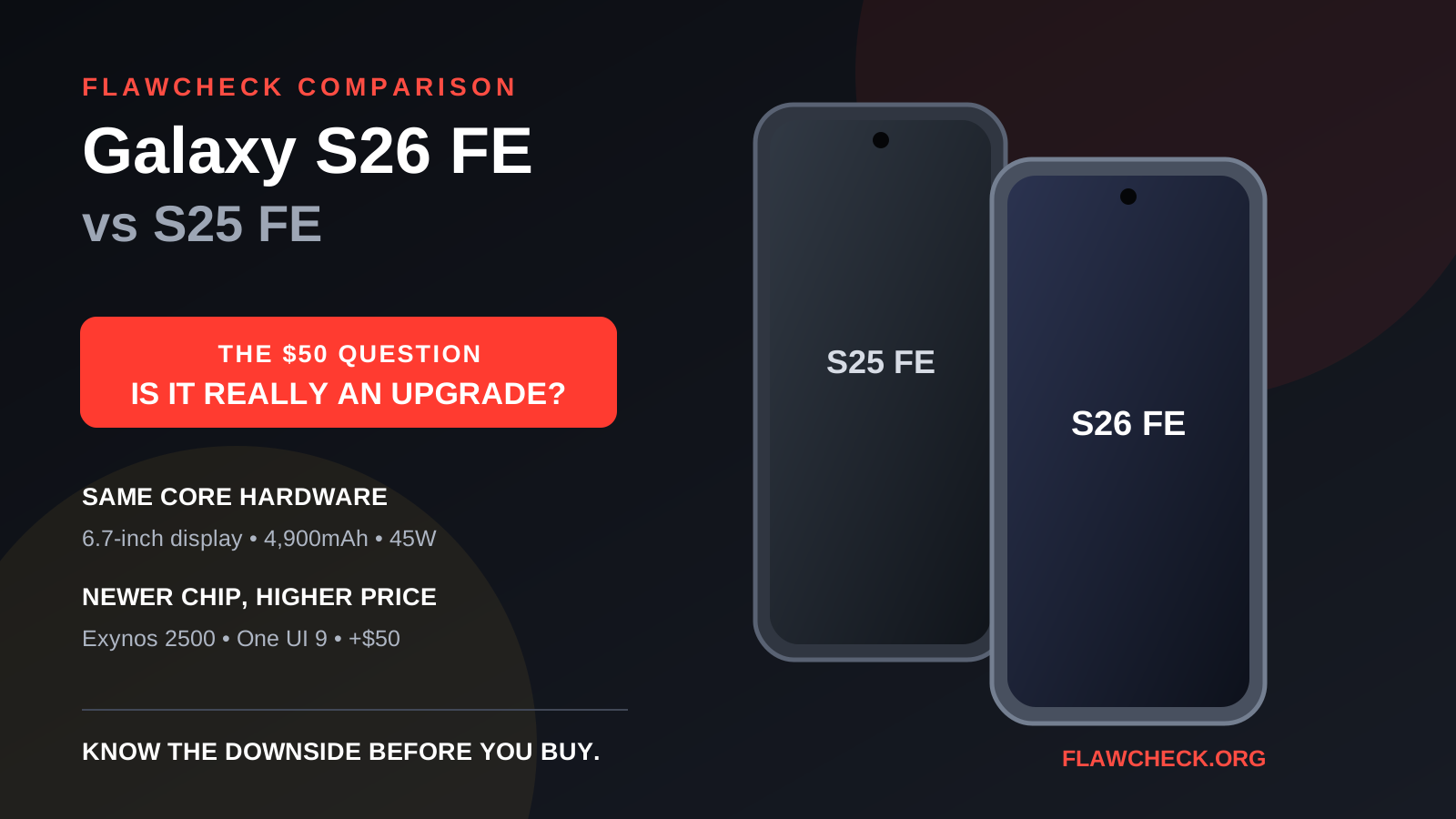
The Samsung Galaxy S26 FE is a difficult annual upgrade to defend. It has a newer Exynos processor, launches with newer software and introduces a few camera and AI tools. Yet the hardware most people experience every day looks remarkably familiar: a 6.7-inch FHD+ display switching between 60Hz and 120Hz, a 4,900mAh battery, 45W wired charging and a 50MP + 12MP + 8MP rear-camera arrangement.
The price moved more than the core experience. Samsung lists the Galaxy S26 FE from $699.99 in the US, compared with the Galaxy S25 FE’s $649.99 launch price. That makes the central question less exciting than Samsung’s feature list suggests: are a newer chip, one extra year of remaining support and several software features worth paying more when the rest of the phone barely changes?
Our answer is blunt: S25 FE owners should not upgrade. New buyers should choose the S25 FE when an equal-storage model is at least roughly $100 cheaper. Choose the S26 FE when the final gap falls to $50 or less, or when keeping the phone for many years makes its longer remaining support window especially valuable.
For the new model’s complete compromise list, read our Samsung Galaxy S26 FE review. New buyers prioritizing price over an annual FE upgrade should also compare the Galaxy S26 FE with Galaxy A57, where the $150 saving changes the value argument. If you are deciding between FE and the compact flagship instead, see Galaxy S26 FE vs Galaxy S26.
Galaxy S26 FE vs S25 FE: specifications and confirmed differences
| Specification | Galaxy S26 FE | Galaxy S25 FE | What it means |
|---|---|---|---|
| US launch price | From $699.99 | From $649.99 | S26 FE costs $50 more |
| Display | 6.7-inch FHD+ Dynamic AMOLED 2X, 60/120Hz, 1,900 nits claimed | 6.7-inch FHD+ Dynamic AMOLED 2X, 60/120Hz | No meaningful format upgrade |
| Processor | Exynos 2500, 3nm | Exynos 2400, 4nm | Confirmed S26 FE upgrade |
| Memory | 8GB | 8GB | No RAM increase |
| Storage | 128/256/512GB, market-dependent | 128/256GB, market-dependent | S26 FE may offer 512GB |
| Main camera | 50MP, OIS | 50MP, OIS | Same headline hardware |
| Ultrawide | 12MP | 12MP | Same resolution |
| Telephoto | 8MP, 3x optical, OIS | 8MP, 3x optical, OIS | Same headline hardware |
| Front camera | 12MP | 12MP | Same resolution |
| Battery | 4,900mAh typical | 4,900mAh typical | No capacity increase |
| Wired charging | 45W | 45W | No rated-speed increase |
| Wireless charging | 15W stated | 15W stated | No clear upgrade |
| Dimensions | 161.6 × 76.9 × 7.4mm | 161.3 × 76.6 × 7.4mm | S26 FE is slightly larger |
| Weight | 193g | 190g | New phone is 3g heavier |
| Launch software | Android 17, One UI 9 | Android 16, One UI 8 | S26 FE starts one generation newer |
| Protection | Victus+, aluminum, IP68 | Victus+, Armor Aluminum, IP68 | Broadly similar on paper |
The table separates published facts from interpretation. Matching specifications do not prove identical performance, but they do establish how little hardware Samsung changed. Likewise, a newer processor does not automatically translate into a dramatic everyday improvement.
Quick verdict: this is a refresh, not a reason to replace your phone
The S26 FE is the better device in a narrow technical sense. It has a newer processor, newer launch software, longer remaining support and several additional video and AI features. If both phones cost exactly the same, choosing the newer model is sensible.
That is not the real buying situation. The S26 FE begins $50 higher than its predecessor did, while discounted S25 FE inventory may widen the actual gap. More importantly, an existing S25 FE owner must absorb depreciation, trade-in conditions or resale friction to obtain improvements that may be hard to notice outside demanding games and a few software tools.
The unchanged 8GB RAM weakens Samsung’s long-term argument. A 3nm processor is welcome, but buyers paying more in 2026 are still receiving the same memory capacity. The unchanged display refresh behavior, camera resolutions and battery specification make the S26 FE feel more like a polished continuation than a new class of FE phone.
Confirmed: the processor and launch software are newer; Samsung added My FanCam and Horizontal Lock; the US starting price is higher.
Not yet proven by FlawCheck: the size of the speed increase, battery-life advantage, thermal improvement or camera-quality gain under matched real-world conditions.
Price and value: the $50 gap is only the starting point
Launch prices are useful historical anchors, not permanent recommendations. Samsung launched the S25 FE at $649.99 and lists the S26 FE from $699.99. Retail discounts, carrier credits, storage promotions and trade-ins can change the decision within hours.
Compare the same storage capacity and calculate the amount you actually pay:
S26 FE checkout price − S25 FE checkout price
Do not subtract a maximum trade-in credit unless your exact phone qualifies. Do not treat bill credits spread across two or three years as an instant discount. Include any plan upgrade, activation fee and charger you must buy.
Use these thresholds:
- Gap of $0–$50: choose the S26 FE. The newer processor and extra remaining support year justify the small premium.
- Gap of $51–$99: close decision. Choose S26 FE for long ownership; S25 FE for immediate value.
- Gap of $100–$150: the S25 FE is usually the better deal for mainstream use.
- Gap above $150: buy the S25 FE unless a specific S26 FE feature solves a real need.
- Already own an S25 FE: skip the upgrade regardless of a normal retail gap; only an unusually generous trade-in changes the calculation.
The downside of buying last year’s model is inventory uncertainty. Your preferred color or storage may disappear, and some discounted units may be carrier-locked. Verify the seller, warranty and model region before treating a lower price as a win.
Design and display: almost the same phone, slightly heavier
Both phones use a 6.7-inch FHD+ Dynamic AMOLED 2X display with 60/120Hz operation. Samsung claims up to 1,900 nits for the S26 FE, but a peak figure describes a controlled condition rather than full-screen sustained brightness. The S25 FE was already a competent large-screen phone; the S26 FE does not introduce the 1–120Hz adaptive panel found on the regular Galaxy S26.
The new phone is 0.3mm taller, 0.3mm wider and 3g heavier. Those differences are tiny, but their direction matters: Samsung did not make the familiar body meaningfully smaller or lighter. At 76.9mm wide and 193g before a case, the S26 FE remains a two-handed phone for many users.
Protection is also familiar. Both carry IP68 claims under laboratory conditions and use Gorilla Glass Victus+. Water resistance can decline with wear and repair, and liquid damage may not be treated like a normal warranty failure. Neither phone should be bought on the assumption that IP68 makes it waterproof forever.
If you disliked the S25 FE’s width, fixed refresh steps or 1080p-class resolution, the S26 FE does not solve those complaints.
Performance, software and long-term support
The move from Exynos 2400 to Exynos 2500 is the clearest hardware upgrade. Samsung identifies the newer chip as a 3nm application processor, while the S25 FE uses a 4nm Exynos 2400. The manufacturing label suggests greater efficiency potential, but it does not quantify speed, heat or battery life by itself.
Early benchmark comparisons may show stronger CPU and graphics results. We are not using isolated benchmark uploads as proof of sustained performance because sample counts, firmware, ambient temperature and cooling state can distort them. Gaming buyers should wait for matched tests measuring frame-rate stability, surface temperature and battery drain over at least 20–30 minutes.
Both phones have 8GB RAM. That is adequate for messaging, browsing, social media, navigation and ordinary photography. It is less reassuring for a phone advertised with seven years of updates and expanding on-device AI. Samsung improved the chip without adding memory headroom.
S26 FE launches with Android 17 and One UI 9. Samsung promises seven major OS upgrades and seven years of security updates. S25 FE received a similar seven-generation commitment at launch, but its clock began one year earlier. For a new buyer planning to keep the phone until the early 2030s, that extra remaining year is meaningful.
For current S25 FE owners, it is not enough. Your phone still has a long support runway. Replacing functional hardware to reset a software-support counter by one year is poor value.
Cameras: the same numbers with newer processing claims
The published camera layout is nearly identical:
- 50MP main camera with optical stabilization.
- 12MP ultrawide.
- 8MP telephoto with 3x optical zoom and stabilization.
- 12MP front camera.
Samsung describes the S26 FE camera experience as enhanced, citing updated processing and features such as My FanCam and Super Steady with Horizontal Lock. My FanCam can track a selected person and reframe a recorded scene. Horizontal Lock is intended to keep video level during movement.
Those are confirmed feature additions. They do not prove that normal photos are dramatically better.
A proper comparison still needs matched samples covering moving children or pets, indoor skin tones, night scenes, shutter delay, lens transitions, 3x detail, digital zoom and long video recording. The Exynos 2500 may improve image processing, but FlawCheck has not tested whether that improvement is visible consistently.
The downside is simple: buyers hoping Samsung used the annual refresh to upgrade the modest 8MP telephoto or introduce a larger main sensor will not find that change in the published specifications. The S26 FE camera may be more capable in software, but its hardware ceiling looks familiar. For a nearby Android alternative built more heavily around computational photography, compare our Google Pixel 11 Pro downside review.
Battery and charging: no capacity upgrade
Both models have a 4,900mAh typical battery and support 45W wired charging. Both support wireless charging. Samsung says the S26 FE can reach roughly 69% in around 30 minutes with the appropriate separately sold adapter; the S25 FE was advertised at up to roughly 65% under its stated conditions.
A four-percentage-point manufacturer claim is not a major charging redesign. Charger, cable, starting temperature, background activity and battery protection settings affect the result.
The Exynos 2500 could make the S26 FE more efficient. That is plausible, not confirmed real-world evidence. The slightly larger body, software behavior, modem conditions and display brightness can offset chip efficiency. Until controlled testing holds those variables constant, the honest verdict is that battery life remains unresolved.
Anyone upgrading specifically for longer endurance should wait. The capacity did not increase, and Samsung’s charging system remains capped at the same nominal power.
Who should avoid it?
Existing Galaxy S25 FE owners
You are the clearest group that should avoid the S26 FE. The transaction replaces a one-year-old phone with essentially the same display class, RAM, battery capacity, charging rating and camera resolutions. A faster chip and newer software are not enough unless your current phone has a specific fault or a near-zero-cost trade-in.
Buyers expecting a major camera upgrade
The camera numbers are almost unchanged. New processing and video tools may help particular scenarios, but the S26 FE is not a hardware leap. Wait for matched photo samples or move to a phone with a demonstrably stronger camera system.
Long-term power users
Seven years of support sounds excellent, but 8GB RAM provides limited headroom for heavy multitasking, emulation, large games and future on-device AI. The regular Galaxy S26’s 12GB RAM and more advanced display may justify spending more if the price gap is manageable.
Small-phone buyers
At 76.9mm wide and 193g before a case, the S26 FE remains large. Buyers who struggle with one-handed reach or hand fatigue should test it physically and compare the compact Galaxy S26.
Bargain hunters who only see the FE name
“Fan Edition” does not guarantee the best Samsung value. A discounted S25 FE can provide nearly the same core hardware for less, while a promoted Galaxy S26 may offer substantially better components for a modest increase. Compare all three final prices.
Who should buy the Galaxy S26 FE?
The S26 FE makes sense for a narrower audience:
- You are moving from an S22 FE-era device, older A-series phone or another aging mid-range model.
- You want a large Samsung display but do not want to pay for the S26+.
- You plan to keep the phone for five to seven years.
- The equal-storage S25 FE is less than $50 cheaper.
- My FanCam or Horizontal Lock directly fits how you record video.
- You value official long-term support more than benchmark leadership.
Even for these buyers, compare the best phones for long-term ownership before purchasing. Update years matter, but battery replacement, repair cost, storage and memory can determine whether long ownership remains practical.
Final verdict
The Galaxy S25 FE wins on value, while the Galaxy S26 FE wins only as the safer new purchase when prices are close.
Samsung confirmed meaningful improvements to the processor, launch software and selected video features. It did not meaningfully change the display format, RAM, battery capacity, charging rating or headline camera hardware. Increasing the US starting price by $50 makes those omissions harder to ignore.
If you already own an S25 FE, keep it. You avoid depreciation and retain most of the S26 FE experience. Reconsider only if a trade-in makes the net cost unusually low or a specific new feature is essential.
If you are buying fresh, choose the S25 FE when an equal-storage, fully warranted model is at least $100 cheaper. Choose the S26 FE when the gap is $50 or less, because its newer processor and additional remaining support year become worthwhile at that point. If neither FE deal is convincing, our Samsung Galaxy buying guide shows when a regular S model or cheaper Galaxy A is the cleaner purchase.
The S26 FE is not a bad phone. It is a weak annual upgrade—and those are different judgments.
Sources and methodology
Confirmed specifications, pricing and feature claims were checked against Samsung’s Galaxy S26 FE announcement, the Samsung US Galaxy S26 FE page, Samsung’s Galaxy S25 FE announcement, the Samsung US Galaxy S25 FE page and Samsung’s Galaxy S25-series comparison support page. Sources were checked September 1, 2026.
FlawCheck has not physically tested these phones side by side. Scores for battery life, thermals, camera quality and sustained performance are provisional and will be updated when controlled evidence becomes available. Read our editorial methodology, editorial policy and corrections policy.
Disclosure
FlawCheck is editorially independent. This comparison is not sponsored by Samsung, and Samsung did not review or approve it before publication. If affiliate links are added later, FlawCheck may earn a commission without increasing the buyer’s price. Affiliate relationships do not determine the verdict, scores or products included.