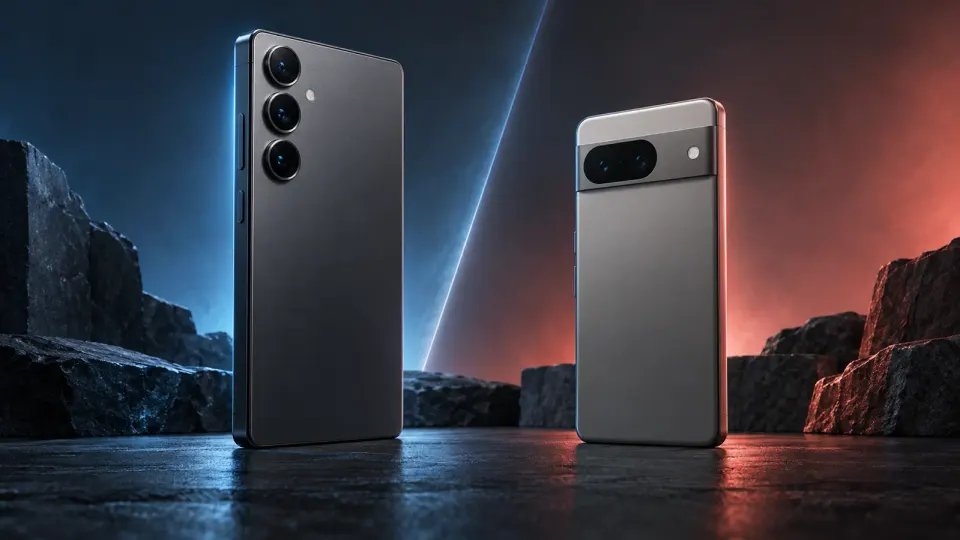
The downside in 20 seconds: The Pixel 10a is the value winner at list price. It saves $200.99 while retaining a 120Hz OLED display, IP68 protection, wireless charging and seven years of updates. The Galaxy S26 FE earns its premium only for buyers who will repeatedly use its 3x telephoto, larger screen, 45W charging, DeX or tighter Galaxy-device integration.
The Samsung Galaxy S26 FE vs Google Pixel 10a comparison is less about which phone has more features and more about whether Samsung’s extra features are worth roughly $200.
At U.S. launch pricing, Galaxy S26 FE starts at $699.99 and Pixel 10a starts at $499. Samsung gives you a larger display, a dedicated 3x telephoto, faster published wired charging and Galaxy ecosystem tools. Google gives you a less expensive, smaller phone with a larger published battery and a similarly long update promise.
Both start with 8GB RAM and 128GB storage. That overlap matters: paying more for the FE does not automatically buy more memory or storage headroom.
This is a research-based comparison, not a hands-on test. FlawCheck has not physically measured either phone’s battery endurance, PWM, thermal behavior, sustained performance, charging curve or camera output. The editorial ratings below are provisional and must not be confused with evidence-approved Flaw Scores.
For Samsung’s complete weakness list, read our Galaxy S26 FE review. Samsung-only buyers should also compare the Galaxy S26 FE with Galaxy S26 and the cheaper Galaxy A57.
Galaxy S26 FE vs Pixel 10a specifications
| Specification | Galaxy S26 FE | Pixel 10a | What it means |
|---|---|---|---|
| U.S. starting price | $699.99 | $499 | Pixel saves $200.99 before promotions |
| Display | 6.7-inch FHD+ Dynamic AMOLED 2X, 60/120Hz | 6.3-inch pOLED, up to 120Hz | Samsung prioritizes size; Google portability |
| Processor | Exynos 2500 | Tensor G4 | Neither launch label proves sustained performance |
| RAM | 8GB | 8GB | No base-memory advantage for Samsung |
| Base storage | 128GB | 128GB | Long-term owners should price 256GB |
| Rear cameras | 50MP main, 12MP ultrawide, 8MP 3x telephoto | 48MP main, 13MP ultrawide | Samsung adds optical reach |
| Battery | 4,900mAh typical | 5,100mAh typical | Pixel leads on capacity, not proven endurance |
| Wired charging | Up to 45W | Up to 23W | Samsung has the stronger headline rate |
| Wireless charging | 15W plus PowerShare | Up to 10W | Both support pads; Samsung is faster on paper |
| Protection | IP68 | IP68 | Both cover a mainstream durability essential |
| Software support | Seven major Android upgrades; up to seven years security | Seven years OS, security and Pixel Drops | Both target long ownership |
Specifications, bands, features and package contents can vary by region. Verify the exact model and storage tier before purchase.
Price: Pixel 10a makes Samsung prove every extra dollar
A $200.99 difference is about 40% of Pixel 10a’s starting price. The FE therefore needs to deliver more than a slightly more premium badge.
Samsung’s premium buys:
- A dedicated stabilized 3x telephoto.
- A larger display.
- Faster published wired and wireless charging.
- Wireless PowerShare.
- Samsung DeX and deeper integration with Galaxy tablets, watches and Windows PCs.
It does not buy more RAM or base storage. Both entry configurations can face the same long-term pressure from larger apps, local AI features and years of accumulated photos and video.
Always compare equal storage and checkout price. If a 256GB promotion narrows the gap below roughly $100, the FE becomes easier to defend. If the gap stays near $200, Pixel 10a forces a clear question: which Samsung-only capability will you use every week?
Cameras: optical reach versus computational confidence
Galaxy S26 FE has the more versatile camera layout. Its 50MP main and 12MP ultrawide are joined by an 8MP stabilized 3x telephoto. Pixel 10a uses a 48MP main and 13MP ultrawide without a dedicated zoom camera.
The FE is the logical choice for concerts, portraits, pets, travel details and subjects you cannot approach. Optical 3x capture is more useful than asking a main sensor to crop every distant scene.
But an extra lens does not settle overall image quality. Pixel phones traditionally rely heavily on processing, and matched testing is still needed for moving subjects, skin tones, HDR, night scenes, shutter behavior and video heat. Samsung’s 8MP telephoto is useful, yet modest for a $700 phone.
Choose Samsung for versatility. Do not declare a universal camera winner until controlled retail-unit comparisons exist.
Performance: both need sustained tests
Exynos 2500 positions Galaxy S26 FE above Google’s Tensor G4 in raw platform ambition. Pixel 10a uses an older Tensor generation than Google’s current flagships, which is one reason Google can hold the $499 price.
Launch specifications cannot answer the questions that matter after ten minutes:
- Does gaming performance fall as the chassis warms?
- How hot does either phone become during navigation or 4K video?
- How efficient is the modem in weak 5G coverage?
- Does camera processing slow under repeated use?
- How much headroom remains after several Android generations?
Samsung is the safer bet for buyers prioritizing higher performance potential. Pixel 10a remains sufficient for messaging, browsing, maps, photography and ordinary multitasking. Because both have 8GB RAM, neither deserves an automatic long-term AI advantage.
Battery and charging: capacity and speed point in opposite directions
Pixel 10a publishes a 5,100mAh battery, 200mAh more than Galaxy S26 FE’s 4,900mAh. Samsung counters with up to 45W wired charging against Google’s published 23W.
The trade-off is simple on paper: Pixel has more stored energy; Samsung can refill faster. Real life is not that simple. Processor efficiency, signal strength, brightness, refresh behavior, background services and charging curves can reverse headline expectations.
Both omit the certainty buyers actually need: comparable mixed-use endurance and full-charge measurements under the same conditions. Until those exist, battery conclusions remain provisional.
Display and comfort: large versus manageable
Galaxy S26 FE’s 6.7-inch display is better for video, reading and split-screen work. Pixel 10a’s 6.3-inch body is easier to carry and more manageable one-handed.
Both advertise OLED-class panels with refresh rates up to 120Hz and IP68 protection. Those shared fundamentals make the choice about physical preference rather than tier.
Display claims still need independent measurements for color accuracy, outdoor brightness, low-brightness behavior and PWM. Buyers sensitive to flicker should not infer comfort from “OLED” or peak-nit marketing alone.
Software and ecosystem: equal duration, different lock-in
Both companies promise a seven-year class of support, but they package that promise differently. Samsung specifies seven major Android upgrades and up to seven years of security updates. Google promises seven years of OS, security and Pixel Drop updates.
Samsung has the stronger cross-device pitch for people already using a Galaxy Watch, tablet, Buds or Galaxy Book. DeX is also a meaningful advantage for users who connect a phone to a larger display.
Pixel 10a offers Google’s direct software experience and generally simpler integration with Google services. The downside on both sides is ecosystem gravity: accessories, cloud services and habits make a future switch more expensive than the handset price suggests.
Our five-year smartphone ownership guide explains why support duration must be considered alongside battery service, storage and repair economics.
Who should buy Galaxy S26 FE?
Choose Galaxy S26 FE if:
- You use 3x zoom every week.
- A large 6.7-inch display is preferable to one-handed comfort.
- Faster charging matters during short top-ups.
- You use Samsung DeX or multiple Galaxy devices.
- A promotion narrows the equal-storage gap substantially.
- You want the higher performance ceiling and accept that sustained tests are still pending.
Avoid paying $699.99 mainly for the S-series identity. The extra money should map to a recurring task.
Who should buy Pixel 10a?
Choose Pixel 10a if:
- Keeping the price near $500 is the priority.
- Most photos are taken with the main or ultrawide camera.
- You prefer a smaller phone.
- Seven years of updates matters more than maximum hardware scope.
- Slower charging is acceptable.
- Saving $200 can fund more storage, a case or future battery service.
Avoid it if optical zoom, DeX or rapid wired charging is already a known requirement.
Final verdict
Pixel 10a wins on value at U.S. list prices.
Galaxy S26 FE is the more complete hardware package. The telephoto camera, larger screen, faster charging and Samsung ecosystem features are real advantages. Yet the FE starts with the same 8GB RAM and 128GB storage while costing $200.99 more.
For mainstream use, Pixel 10a preserves enough of the modern-phone baseline to make Samsung justify its premium feature by feature. Buy the Pixel when price, compactness and ordinary photography dominate. Buy the FE when optical zoom, charging speed, DeX or Galaxy integration will be used repeatedly—and preferably after a discount.
Do not pay $200 for capabilities that will remain menu items.
Sources and methodology
Specifications and support claims were checked against Google’s Pixel phone hardware specifications, Google’s Pixel update policy, Samsung’s Galaxy S26 FE product page and Samsung’s Galaxy S26 FE launch announcement.
FlawCheck has not physically tested either device. Manufacturer documentation establishes configuration and claims, not real battery life, camera quality, PWM behavior, thermals or sustained speed. Read our editorial methodology, editorial policy and corrections policy for how research-based evidence and provisional ratings are handled.