Launch-stage evidence notice: Apple has announced the iPhone Duo, but retail availability does not begin until October 23, 2026. This article separates verified hardware differences from image-quality conclusions that require matched retail testing. We are not scoring either camera system from a spec sheet.
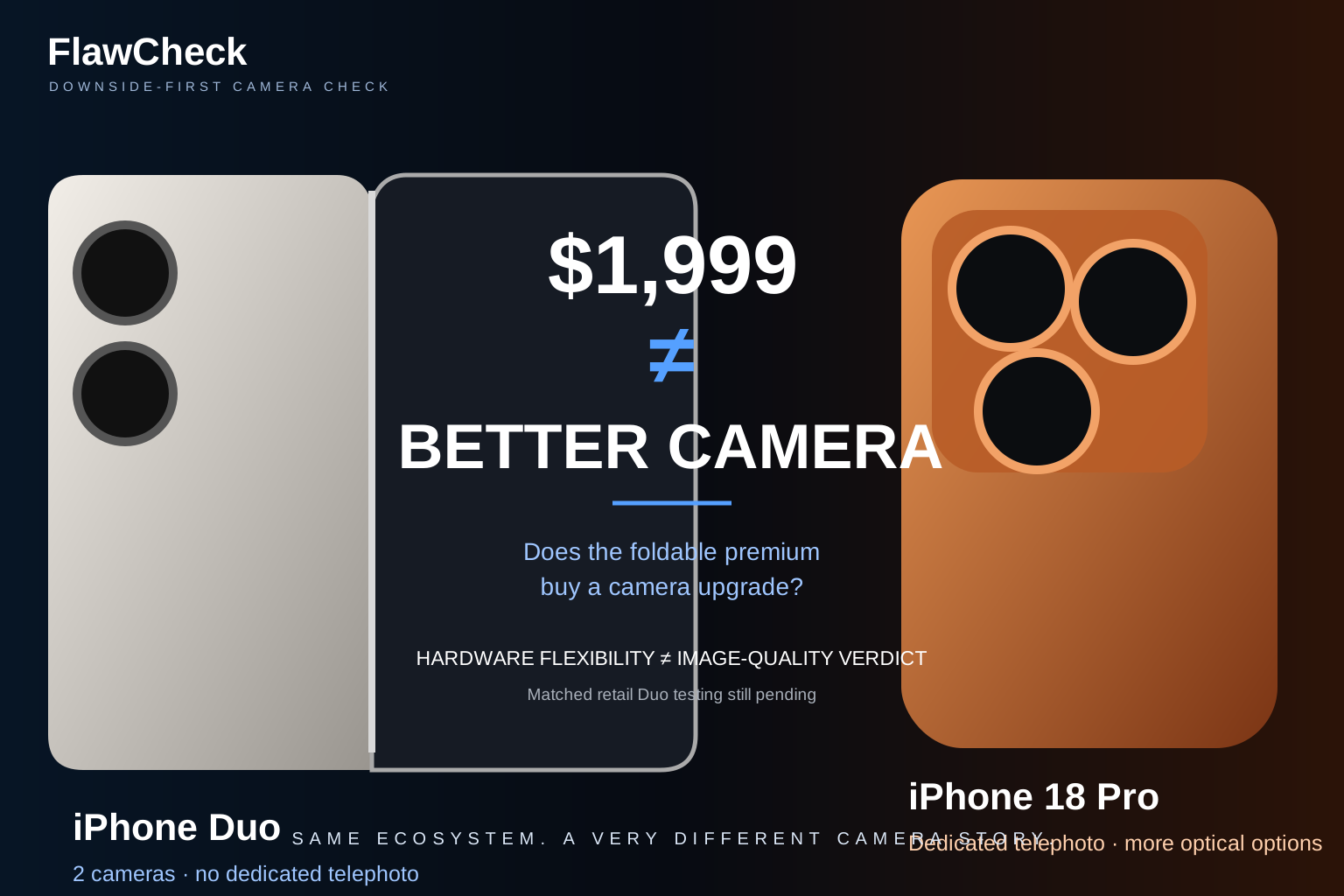
The uncomfortable question about the iPhone Duo vs iPhone 18 Pro camera is not whether Apple’s first foldable can take good photos. It almost certainly has enough modern camera hardware and processing to cover everyday snapshots. The more useful question is this: why does a $1,999 iPhone ask camera-focused buyers to accept less lens flexibility than the iPhone 18 Pro?
That is the downside-first way to look at Apple’s foldable. The Duo’s premium is paying for a folding display, hinge engineering and a new form factor. It is not a camera upgrade fee. If you photograph children across a field, details on buildings, concerts, travel subjects, portraits or anything else where focal length matters, the missing dedicated telephoto deserves more attention than the headline price suggests.
The short verdict is simple: buy the iPhone Duo because you want a foldable iPhone, not because you expect Apple’s best camera system. For a camera-first buyer, the iPhone 18 Pro is the safer choice until matched retail tests prove that Duo’s computational photography can close more of the gap than its hardware implies.
iPhone Duo vs iPhone 18 Pro camera: the difference that matters
| Camera question | iPhone Duo | iPhone 18 Pro | Why it matters |
|---|---|---|---|
| Dedicated telephoto | No | Yes | Pro has a separate optical path for longer focal lengths |
| Short-range zoom | Main-sensor crop / computational options | Main-sensor crop plus dedicated telephoto options | Both can crop, but Pro has more hardware to work with |
| Portrait flexibility | More dependent on main-camera framing/crop | More focal-length choices | Longer focal lengths can produce more flattering perspective from farther away |
| Distant subjects | Bigger compromise | Stronger fit | Telephoto hardware matters more as subject distance increases |
| Low-light zoom | Needs retail testing | Better hardware position, but still scene-dependent | Cropping a main sensor can become more costly when light is scarce |
| Main-camera processing | Modern Apple computational pipeline | Modern Apple computational pipeline | Processing can affect both; Pro hardware does not automatically mean more natural rendering |
| Foldable shooting experience | Unique advantage | Conventional slab | Duo may offer useful self-supporting angles and a larger review canvas |
| Camera-first value | Questionable at $1,999 | Stronger | Duo’s premium buys the fold, not a telephoto upgrade |
The table is deliberately not a fake laboratory score. We know the hardware distinction. We do not yet have matched retail Duo samples under identical light, distance and processing settings.
The $1,999 problem: paying more does not mean getting more camera
Premium-phone pricing creates a reasonable expectation: move higher in the range and fewer compromises should remain. The Duo breaks that intuition.
At $1,999, it sits in ultra-premium territory, yet Apple has made a packaging choice familiar from other thin foldables: camera hardware has to compete with hinge space, battery volume, display layers, thermal constraints and closed-body thickness. The result is a product whose defining engineering achievement is the fold, while camera buyers lose a dedicated telephoto compared with the Pro.
That does not make the Duo a bad phone. It makes the purchase decision unusually specific.
If the inner display changes how you work, read, multitask or consume media, the compromise may be rational. If your mental model is simply “the most expensive iPhone should also have the best camera,” the Duo is the wrong product to buy on that assumption.
This is also why our broader iPhone Duo vs Galaxy Z Fold7 vs Pixel 11 Pro Fold comparison treats the Duo as a form-factor and ecosystem decision rather than an automatic flagship-hardware winner.
Infographic: where the camera compromise actually appears
Likely small concern. Main-camera quality and processing dominate.
High-resolution sensor cropping can remain useful in good light.
The lack of a dedicated telephoto becomes more relevant.
Highest risk area. Wait for matched retail samples.
The point is not that every Duo zoom photo will be poor. It is that the risk rises with magnification and difficult light, exactly where a dedicated telephoto becomes more valuable.
Sensor crop is useful — but it does not make the missing lens disappear
Modern phone makers can take a high-resolution main sensor, read a smaller central region and output a lower-resolution image with a narrower field of view. In favorable conditions, that can look much better than old-fashioned digital enlargement.
But the physical tradeoff remains: the camera is using less of the sensor area for that cropped field of view. As magnification increases, there is less captured information available before reconstruction, sharpening and other computational steps have to do more work.
That distinction is the reason we wrote our evergreen explainer on optical-quality zoom vs optical zoom. “Optical-quality” can describe a useful result, but buyers should still ask which lens and how much sensor area produced it.
For the Duo, this matters because a cropped main-camera view is not a hardware substitute for every situation where the 18 Pro can switch to a dedicated longer-focal-length camera.
Portraits may be the sleeper downside
People often think telephoto cameras are only for extreme zoom. Portraits are one of the more practical reasons to care.
To frame a face tightly with a wide main camera, you either move physically closer or crop. Moving closer changes perspective: features nearer the lens can look more prominent. Standing farther back and using a longer focal length can give a more natural-looking facial perspective while preserving the composition you want.
The iPhone Duo may still create attractive portraits through depth estimation, computational blur and main-sensor detail. What it cannot manufacture is the physical shooting position and optical path of a dedicated telephoto lens.
That makes iPhone Duo portrait camera, iPhone Duo telephoto lens and iPhone Duo camera limitations more useful buyer questions than simply asking how many megapixels the phone has.
Distant subjects are where the spec-sheet compromise becomes obvious
Consider four ordinary situations:
- your child is on the other side of a sports field;
- you want architectural detail near the top of a building;
- you’re photographing a performer from your seat;
- you want a compressed travel landscape without walking much closer.
Those are not niche “100x zoom” stunts. They are normal reasons to want a longer focal length.
A main-sensor crop can bridge part of the distance, especially outdoors in strong light. But the farther you push it, the more you are asking a smaller crop plus computational processing to compete with a camera designed for a narrower field of view.
For buyers searching iPhone Duo zoom vs iPhone 18 Pro, this is the core answer: the Pro gives you more optical options before software has to compensate.
Low-light zoom is the question we refuse to answer before retail testing
It would be easy to turn the missing telephoto into a sweeping claim that the Duo will always lose at night. That would be premature.
Phone cameras switch lenses dynamically. Depending on light, focus distance and software logic, even a phone with a telephoto module can sometimes prefer a crop from another sensor. Noise reduction, multi-frame fusion, stabilization and exposure time can change the result substantially.
So our evidence line is narrower: Duo has less dedicated telephoto hardware; whether that produces a visible loss in a specific low-light scene must be tested.
When retail units ship, a useful test should hold constant:
| Test | What to compare | What would count as a real downside? |
|---|---|---|
| Daylight 2x/4x | Fine text, foliage, hair | Lost micro-detail or obvious sharpening artifacts |
| Indoor portrait | Skin texture, motion, focus | More smearing or unstable detail |
| Night zoom | Signs, windows, lights | Noise, watercolor texture, haloing |
| Video zoom | Detail during movement | Jumps, instability, processing changes |
| Portrait distance | Perspective and edge separation | Forced closer shooting or weaker subject detail |
Until those tests exist, “camera downgrade” should mean a downgrade in hardware flexibility, not an invented claim that every Duo image is worse.
The iPhone 18 Pro has its own camera caveats
Choosing the Pro does not end the downside analysis.
First, a dedicated telephoto is not automatically the camera used at every zoom setting. Phone camera apps can blend, crop and switch modules based on conditions. Our optical-quality zoom explainer is relevant to the Pro too. The companion guide on what you lose when a 2x crop replaces a dedicated telephoto turns that mechanism into a daylight, indoor, portrait and reach decision.
Second, the iPhone 18 Pro’s variable-aperture system adds flexibility but also deserves scrutiny as a real-world feature rather than a spec-sheet trophy. The useful question is whether it changes depth of field, exposure or image character enough to matter in everyday shooting—not whether a mechanical feature sounds more “camera-like.”
Third, Apple’s computational look can be polarizing. If your complaint is aggressive HDR, local contrast or sharpening rather than missing focal lengths, read why iPhone photos can look overprocessed—and what you can actually control. More camera hardware does not necessarily solve a processing preference.
What the Duo gives you instead of the telephoto
The fold itself can create photographic advantages that do not appear in a conventional camera-spec table.
A partially folded phone may support itself for group photos, time-lapses or lower-angle compositions. A larger inner screen can be useful for reviewing focus and framing. Foldable software may enable preview or control patterns that a slab phone cannot duplicate.
Those benefits could matter more than telephoto reach for some owners. But they are workflow advantages, not evidence that the Duo has a better camera system.
That distinction keeps the purchase logic clean:
Duo: pay for the fold and accept camera compromise.
18 Pro: give up the fold and get the more complete camera toolkit.
Who should avoid the iPhone Duo because of its camera?
The Duo is a risky $1,999 choice if you regularly shoot subjects you cannot physically approach. Parents shooting sports, concert-goers, frequent travelers, portrait enthusiasts and anyone who habitually uses longer focal lengths should not assume computational zoom will erase the hardware difference.
It is also a questionable choice if you upgrade rarely. A missing lens cannot be added later with a software update. If telephoto flexibility becomes important during several years of ownership, the compromise remains for the life of the device.
Conversely, if 90% of your photos are 1x family snapshots, food, documents and casual daylight scenes, the telephoto gap may matter far less than the foldable screen you use every hour.
Flaw Intelligence: what we can record now, and what remains candidate evidence
This comparison is designed to feed FlawCheck’s structured evidence system without pretending launch information is long-term proof.
| Flaw candidate | Category | Evidence status | Potential ownership impact | What would verify it? |
|---|---|---|---|---|
| Missing dedicated telephoto | Camera / value | Verified specification | Medium–high for zoom-heavy users | Official camera specification already establishes hardware absence |
| Weaker long-range detail | Camera | Candidate | Medium | Matched retail daylight tests |
| Weaker low-light zoom | Camera | Candidate | Medium | Matched retail night tests at equal framing |
| Less portrait focal-length flexibility | Camera / usability | Hardware-supported inference | Medium for portrait users | Matched portrait distance/framing tests |
| $1,999 camera-value tradeoff | Value | Verified price + specification; subjective impact | Buyer-dependent | User priorities and competing iPhone pricing |
We deliberately do not turn those rows into a numerical Flaw Score. The Duo is not on sale yet, independent long-term evidence does not exist, and camera performance is not responsibly reducible to lens count.
The buying decision in one sentence
If you are choosing between iPhone Duo and iPhone 18 Pro primarily for photography, buy the 18 Pro; choose the Duo only when the foldable experience is valuable enough that you knowingly accept the less complete camera hardware.
That is the part the $1,999 price can obscure. The Duo may be Apple’s most ambitious iPhone, but “most expensive,” “most innovative” and “best camera” are three different claims.
For buyers considering the foldable anyway, read our first-generation iPhone Duo risk guide before preorder. The camera compromise is only one part of the ownership equation; hinge durability, inner-display wear, repair economics and first-generation software behavior may matter more over several years.
Sources and evidence notes
This article prioritizes Apple’s announced specifications and launch information for hard product facts, then uses optical principles only to explain why the hardware difference can matter. Retail image-quality claims are intentionally deferred until matched testing is available.
- Apple, iPhone Duo product and technical information, checked September 13, 2026.
- Apple, iPhone 18 Pro product and technical information, checked September 13, 2026.
- Reuters launch coverage, September 2026, used as independent confirmation of iPhone Duo’s $1,999 positioning.
- FlawCheck internal optical-zoom methodology: distinguish physical focal-length changes from high-resolution sensor crops and computational reconstruction.
Update plan: after October 23 retail availability, replace candidate claims with matched 1x/2x/telephoto daylight, portrait, low-light and video evidence. If the evidence contradicts the hardware-based risk assessment, this article will be revised rather than preserving the launch thesis.