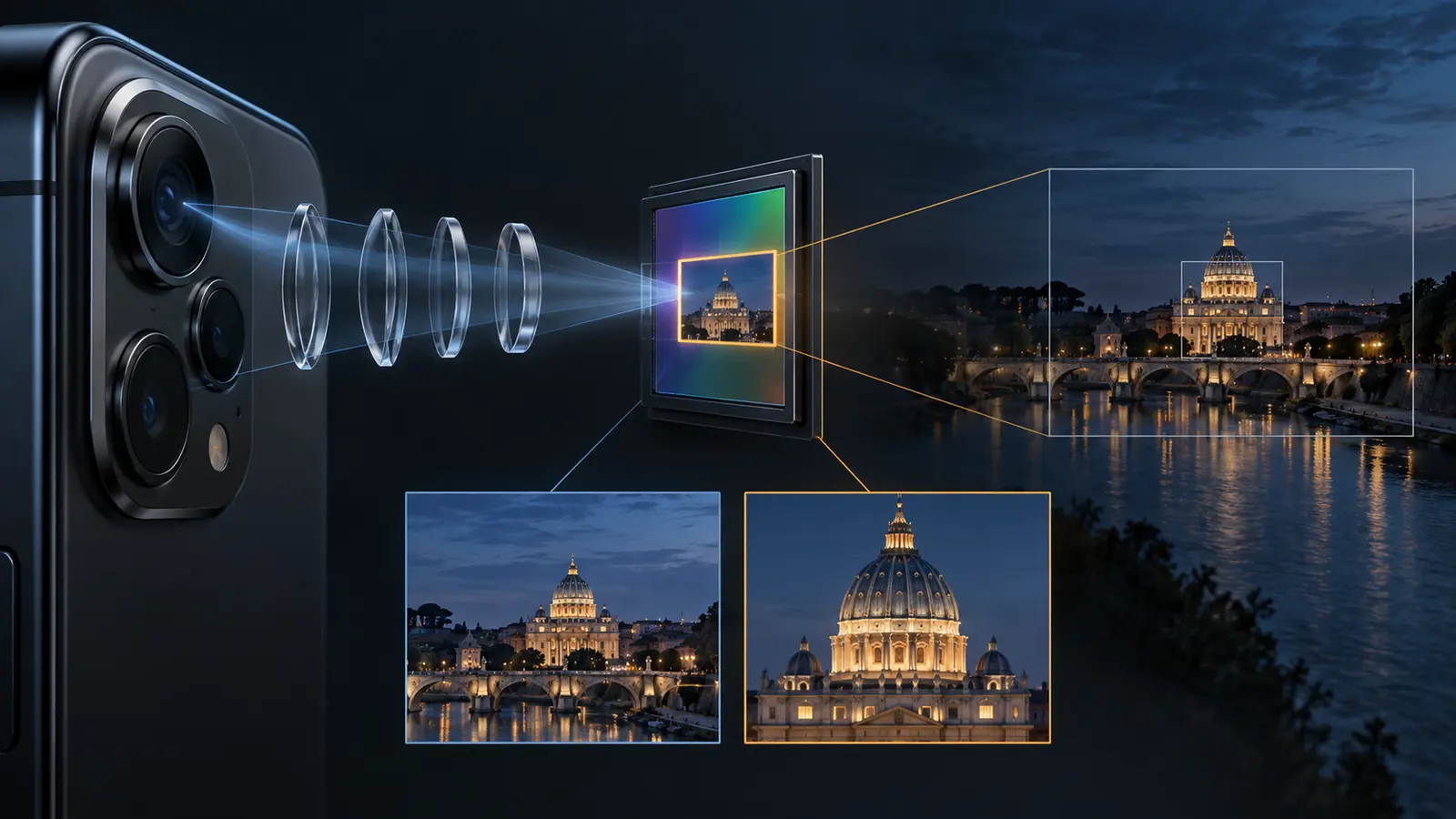
The word that should make you slow down in a phone-camera specification is not zoom. It is quality.
Apple, Samsung and other phone makers increasingly list both “optical zoom” and “optical-quality zoom.” The two phrases look almost interchangeable on a product page. They are not. One describes where magnification happens; the other describes how good the manufacturer believes the result looks.
That distinction matters because one zoom slider can conceal several capture methods. A marked stop may correspond to a separate fixed lens, the center of a high-resolution sensor, an enlarged crop, or a multi-frame reconstruction. This article is the terminology map: it identifies the mechanism behind 2x, 8x and 10x labels. For the narrower purchase question, use our 2x optical-quality versus real telephoto comparison.
For the pixel arithmetic behind that crop, see phone camera megapixels explained: a two-times linear crop retains one-quarter of the starting grid, before resampling. That calculation does not establish zoom quality.
For the wider system behind these trade-offs, read our phone camera specifications guide, covering sensors, lenses, focus, exposure and processing.
Our phone sensor-size guide explains full area versus the region used by a crop, and why a main-camera size label cannot establish every zoom result.
The short answer
Optical zoom changes image magnification through the lens before the light reaches the sensor. Optical-quality zoom is a claimed quality level and may be produced by cropping a high-resolution sensor.
On a typical 48MP camera, a 2x center crop uses the middle 12MP. Because doubling the linear crop factor leaves one quarter of the original area, the phone can deliver a 12MP image without upscaling—but it has discarded three quarters of the sensor area for that frame.
That is why “just digital zoom” is too dismissive, while “the same as optical zoom” is too generous.
FlawCheck buying rule: count only documented native lens focal lengths as optical steps. Treat every “optical-quality,” “lossless,” “hybrid” or unmarked in-between step as a crop or computational result until matched original files prove it meets your needs.
Optical-quality zoom vs optical zoom
| Zoom type | What changes the framing? | Sensor area used | Pixels may be invented? | Main downside |
|---|---|---|---|---|
| Native optical lens | Lens/focal length before capture | Normally the full paired sensor | No, at the native output | Extra lens may be small, slow or absent in low light |
| Mechanical optical zoom | Moving lens elements vary focal length | Full sensor across the designed range | No, at native output | Rare in phones; adds size and mechanical complexity |
| High-resolution sensor crop | Center portion of one sensor | Falls as crop increases | Not until crop resolution drops below output resolution | Less total light and less oversampling |
| Interpolated digital zoom | Crop plus enlargement | Small center region | Yes | Softer texture, artifacts and exaggerated processing |
| Hybrid or AI zoom | Crop, frame fusion and reconstruction | Varies by phone and scene | Often | Result can be scene-dependent and hard to predict |
Most smartphones do not contain a miniature version of a conventional 24–120mm zoom lens. They use several fixed camera modules—perhaps ultrawide, main and telephoto—then make the slider feel continuous with crops, lens switching and computational fusion.
So a phone labeled 0.5x, 1x, 2x, 4x and 8x may have only three native optical perspectives. The other buttons can still be valuable, but they should not all receive the same evidentiary weight.
Where a high-resolution crop fits
A high-resolution sensor crop sits between two ideas often collapsed into digital zoom. A 2x linear crop of a roughly 48MP sensor keeps half the width and half the height, leaving about 12MP. It can therefore retain a native sample for each output position instead of enlarging a much smaller file.
That makes it meaningfully different from cropping a 12MP image to 3MP and stretching it back to 12MP. It does not make the lens optical at 2x. The main lens formed the same image; the phone selected a smaller part of it.
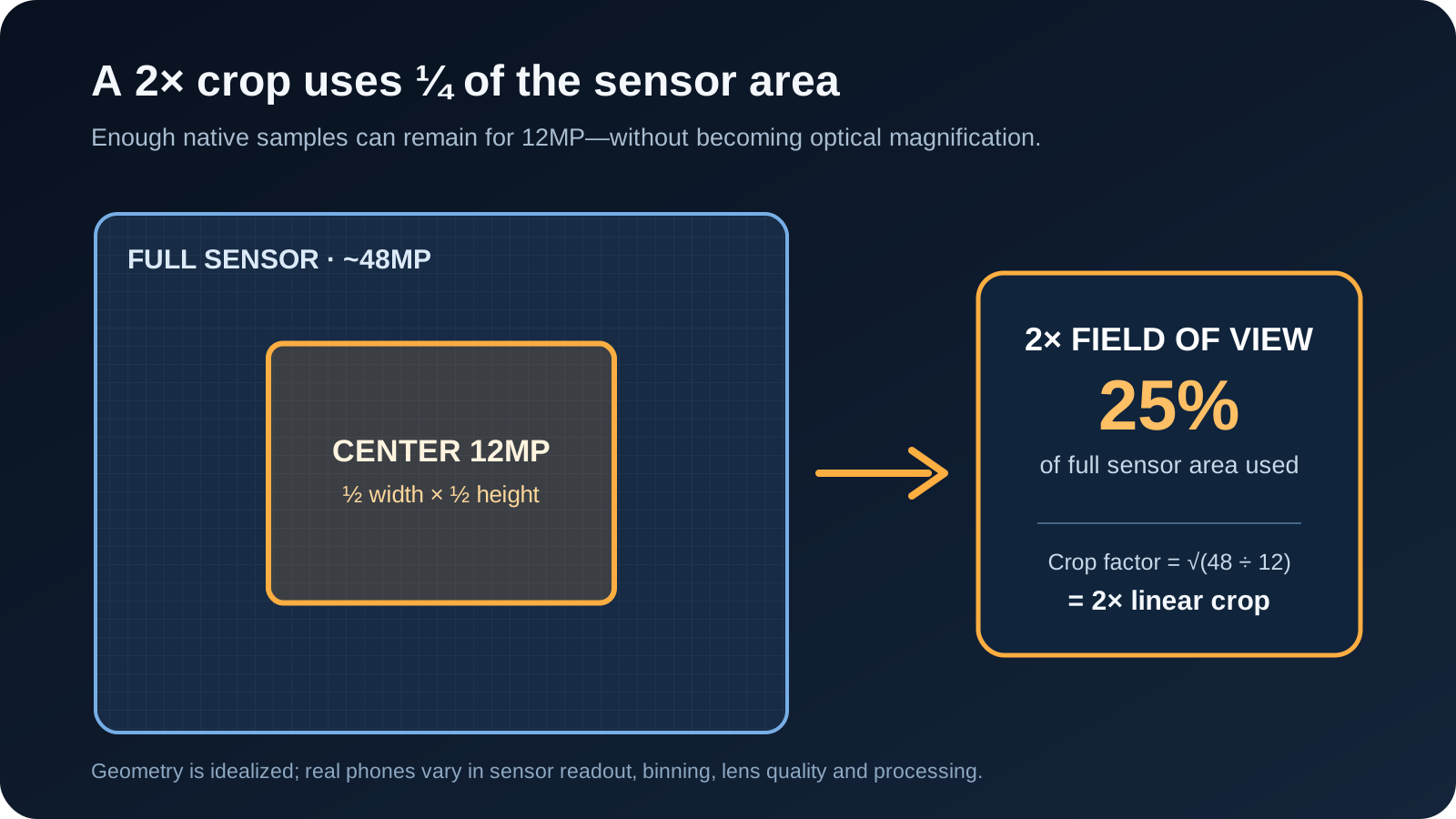
This distinction scales beyond 2x. An 8x optical-quality stop can be a crop from a native 4x telephoto sensor; 10x optical-quality can be derived from a native 5x module. The first number describes a physical lens position. The second adds a quality claim about what crop and processing can deliver.
What the label tells you—and what it hides
Optical-quality tells you that the manufacturer considers the output comparable to some optical reference under its chosen conditions. There is no shared threshold requiring the same sensor area, aperture, shutter speed, texture retention or motion performance across brands.
The label does not identify which camera supplies the frame, how much sensor area is read, whether output requires reconstruction, or whether the phone uses the same path in low light and video. Those remain specification and test questions.
This glossary therefore classifies mechanisms without declaring a universal image-quality winner. For matched daylight, indoor, portrait and distance scenarios, read what 2x crop zoom loses against a dedicated telephoto.
What current Apple and Samsung wording tells us
Apple’s current iPhone 18 Pro technical specifications separate “optical-quality” zoom from optical zoom. That wording itself is useful disclosure: buyers should not assume every number in the stated range corresponds to a separate native lens.
The earlier iPhone 17 technical specifications describe a 48MP Fusion main camera that also enables a 12MP optical-quality 2x telephoto view. One physical main-camera lens cannot simultaneously become a second fixed optical focal length; the extra field of view comes from the sensor and processing path.
Samsung is similarly explicit in its Galaxy S26 launch specifications, distinguishing 3x and 5x optical distances from 2x and 10x optical-quality distances enabled by its Adaptive Pixel sensor.
These official pages establish terminology and hardware claims. They do not independently prove equal image quality between the optical and cropped positions. Manufacturer samples are useful demonstrations, but a buying conclusion still needs matched scenes and original files.
Is sensor crop the same as digital zoom?
In mechanism, a center crop is digital framing: the lens has not increased magnification. In outcome, there are two useful stages to separate.
- Native-resolution crop: enough actual sensor samples remain to create the requested output dimensions. A 48MP-to-12MP 2x crop is the familiar example.
- Interpolated crop: too few samples remain, so software enlarges or reconstructs the image to reach the output size.
Both use less sensor area than the full view. The first avoids a straightforward resolution shortfall; the second must also estimate missing output information. Calling both “digital zoom” is technically defensible, but it hides a meaningful quality difference. Calling the first “optical zoom” hides an equally meaningful mechanism difference.
“In-sensor zoom” or “sensor crop” is the clearest language.
How to audit any advertised zoom range
1. List physical camera modules
Start with each documented equivalent focal length and aperture. A distinct lens-and-sensor module, or a documented variable optical assembly, establishes a native optical position. A camera-app button does not.
2. Map every extra number to a source camera
If a 48MP main camera enables 2x, record it as a high-resolution main-sensor crop. If a 48MP 4x telephoto enables 8x, record 4x as native and 8x as crop-derived. This prevents an advertised range from being mistaken for continuous optical zoom.
3. Separate native crop from enlargement
Check whether enough sampled pixels remain for the stated output resolution. Once the retained region falls below output size, interpolation or reconstruction becomes unavoidable. Multi-frame processing may help, but the result remains evidence-dependent.
4. Expect the capture path to change
Phones may switch modules, blend cameras or fall back to a brighter lens depending on light and focus distance. Specifications describe available hardware; they do not guarantee what automatic mode selects for every frame.
5. Verify stills and video separately
A still can combine several frames and conceal a transition. Video has different resolution, frame-rate and stabilization constraints. Availability in one mode does not prove identical behavior in another.
This audit identifies what the phone is doing. The separate 2x crop-versus-telephoto buying guide answers whether that path is good enough for portraits, motion, low light and distance.
How marketing turns mechanisms into a bigger zoom range
A larger optical-quality number does not necessarily mean another lens was added. Ask whether the model introduces a different native focal length, improves the sensor behind an existing lens, or merely extends crop and reconstruction.
Terms also describe different layers. Variable aperture describes an optical mechanism; optical-quality describes an output claim; hybrid zoom describes a mixed computational path. None independently proves a better photograph. See the iPhone 18 Pro variable-aperture analysis for the difference between confirmed hardware and unverified outcomes, and why iPhone photos look overprocessed for the processing layer.
The defensible reading order is: identify the mechanism here, evaluate the real-world tradeoff in the 2x sensor-crop versus telephoto guide, then use a model comparison for the final purchase decision.
Verdict
Optical-quality zoom is not necessarily fake. It is simply not the name of an optical mechanism.
Use native optical for a lens-defined focal length, sensor crop when the phone reads a smaller region, digital zoom when that region must be enlarged, and hybrid or computational zoom when multiple frames, cameras or reconstruction contribute. These labels describe how an image is made; they do not rank the final image automatically.
This page decodes the specification. Once you know which stops are lenses and which are crops, continue to the 2x optical-quality versus real telephoto guide for the buyer-facing question of low light, motion, portraits and useful distance.
Sources and disclosure
Current terminology was checked against Apple and Samsung product documentation on September 12, 2026. Resolution examples explain the geometry of an idealized 48MP-to-12MP center crop; actual sensor dimensions, readout modes, pixel grouping and processing vary by device. FlawCheck has not claimed hands-on testing and assigns no numerical score to this guide.



