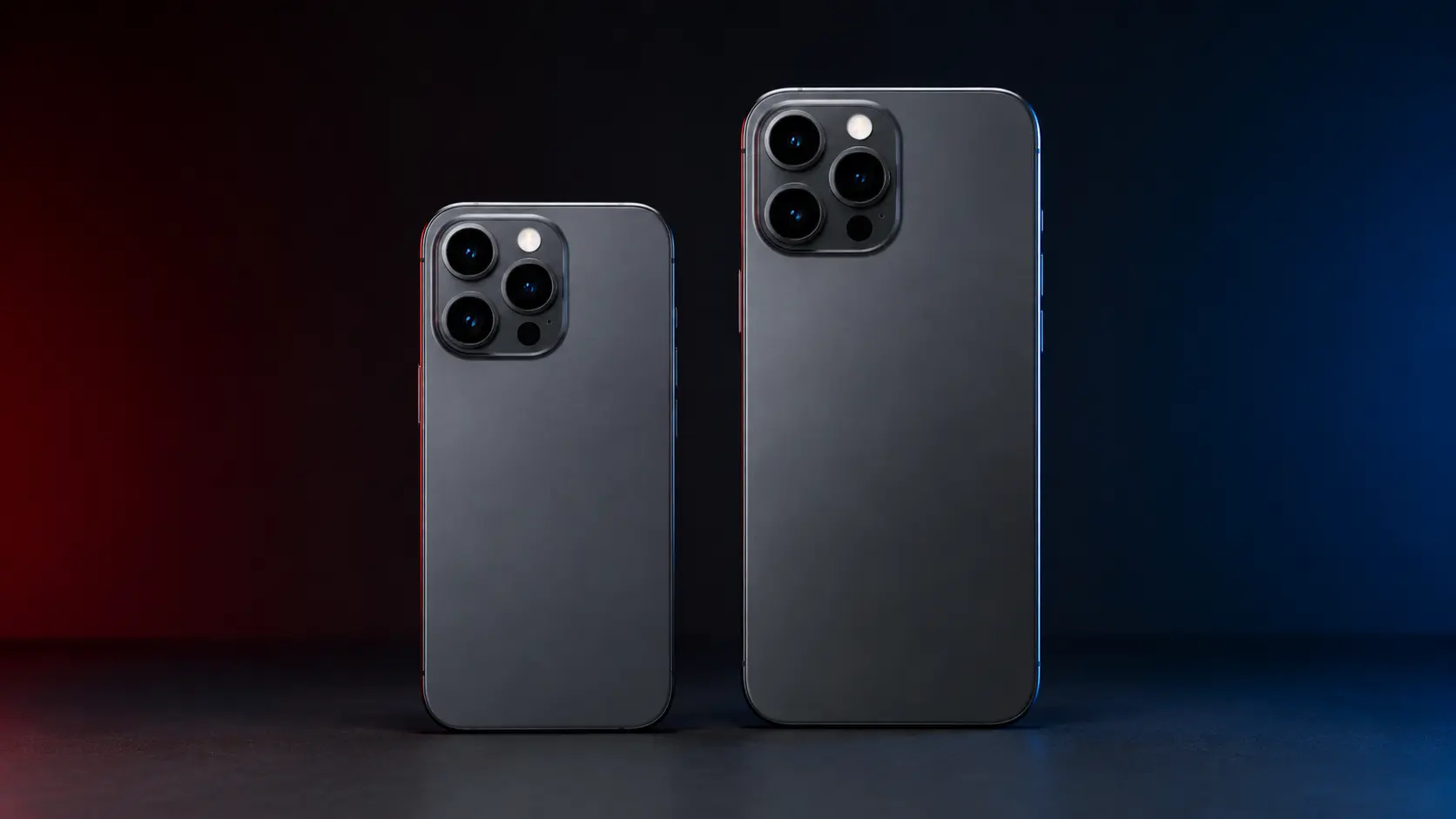
Post-launch evidence notice: iPhone 18 Pro Max is official. FlawCheck has not independently tested retail battery life, sustained thermals, camera consistency or C2 modem behavior, so this article deliberately does not assign a numerical product score.
The iPhone 18 Pro Max does not need to be a bad phone for upgrading from the iPhone 17 Pro Max to be a poor decision. A one-year replacement has to clear a much higher bar than a purchase from an older device because the current phone is already paid for, configured and familiar.
Apple’s new Pro Max starts at $1,299 in the US and brings A20 Pro, next-generation vapor-chamber cooling, a 48MP variable-aperture main camera and the C2 modem. Those are real post-launch changes. The downside-first question is whether they materially improve your ownership enough to repay the cost, depreciation and disruption of replacing a recent flagship.
Quick comparison
| Area | iPhone 17 Pro Max | iPhone 18 Pro Max | Downside-first read |
|---|---|---|---|
| Product status | Previous-generation flagship | Current official flagship | Newer does not automatically mean better value |
| Starting price | Existing owners already absorbed purchase cost | $1,299 US | Replacement economics are the first hurdle |
| Processor | A19 Pro | A20 Pro, 2nm | Test sustained speed, heat and efficiency |
| Main camera | Previous Pro camera system | 48MP variable aperture | Verify low light, motion and video consistency |
| Cellular | Earlier modem generation | Apple C2 | Weak-signal behavior needs carrier-specific testing |
| Battery | Known behavior on an owned device | 18:27 vs 17:54 in one 5G web test | Mixed-use independent endurance matters most |
| FlawCheck score | Not scored here | Not scored here | Evidence gate remains active |
Start with the problem your 17 Pro Max actually has
An upgrade is easier to justify when it solves something concrete. Examples include a battery that no longer survives your workday, repeatable thermal throttling in a professional workflow, insufficient storage, recurring modem problems in places you use daily, or a camera limitation that costs you usable shots.
“The new one is faster” is not a problem by itself. Neither is a headline feature you cannot connect to a recurring pain point.
Our iPhone 18 Upgrade Guide uses the same rule: upgrade by problem and ownership condition, not by generation number.
Battery is the strongest upgrade case — but the measured gain is modest
Apple positions the iPhone 18 Pro Max as a major battery-life step. For a Pro Max buyer, that is arguably more important than peak benchmark gains because battery endurance affects navigation, camera use, travel, hotspot sessions and long cellular days.
In Tom’s Guide’s retail review, the 18 Pro Max averaged 18:27 against 17:54 for the 17 Pro Max: 33 minutes, or about 3%, under continuous 5G web browsing at 150 nits. That is evidence of a gain in this protocol, not proof of a whole extra day. Apple lists up to 45 hours of video playback for the 18 Pro Max; that is a different workload. However, one test is not enough to predict your day. Useful comparison testing should hold brightness, network conditions and workload mix as constant as possible and report screen-on time, standby drain, camera duration, navigation time, 5G use, surface temperature and regional model configuration.
Upgrade threshold: if your 17 Pro Max currently forces a recharge during a normal day, the new model should produce a repeatable full-day advantage in that same workload. If it only adds a small reserve at bedtime, the improvement may be pleasant without being worth a $1,299 replacement.
A20 Pro: benchmark gains are not automatically ownership gains
A20 Pro is a meaningful platform change, but the 17 Pro Max already has substantial performance headroom for messaging, browsing, video, photography and most games. The cases where A20 Pro matters most are sustained workloads: long video exports, high-end gaming, local AI processing, repeated photo batches or hot-environment navigation and recording.
The same retail review reported 79.4% stability for the 18 Pro Max versus 65.2% for the 17 Pro Max in 3DMark Wild Life Extreme Stress Test. This supports a sustained graphics improvement in that test, not a claim about every game or surface temperature. The right evidence is not one short benchmark run. Look for completion time, sustained clocks, surface temperature and battery consumed over the same workload. A faster chip that also draws more power or reaches uncomfortable temperatures can be a weaker ownership upgrade than its launch chart suggests.
Variable aperture: technically interesting, still easy to overvalue
The 48MP variable-aperture main camera gives Apple more optical flexibility, but the feature name alone does not prove better photography. What matters is whether it improves motion capture, low-light shutter behavior, highlight handling, depth rendering, edge sharpness and video exposure consistency.
Matched scenes are especially important for a one-generation upgrade. A camera difference that is visible only when pixel-peeping static scenes is much harder to justify than one that repeatedly saves difficult moving subjects or night shots.
C2 modem: test where your old phone struggles
Modem improvements are among the hardest launch claims to generalize. Carrier bands, firmware, congestion, handoffs, signal strength and local geography all affect results.
If cellular quality is your reason to upgrade, do not rely on a generic speed test. Compare the two devices in the places where your 17 Pro Max actually struggles: elevators, parking structures, trains, weak indoor coverage and congested commutes. Also compare battery drain during those sessions.
A U.S. test cannot automatically prove behavior on Vietnamese networks, and one carrier cannot stand in for another.
The Pro Max tax is also ergonomic
Apple lists 249 g for the 18 Pro Max, versus 233 g for the 17 Pro Max in the cited retail comparison. That 16 g difference will matter more to some owners than the measured 33-minute battery gain. Battery capacity and cooling volume need physical space. A larger phone can be excellent for media, navigation and editing while remaining tiring one-handed or uncomfortable in pockets and mounts.
Before choosing Pro Max, evaluate it with the case you intend to use. Weight distribution, reachability and long-session comfort are ownership flaws that specification tables rarely capture.
If you want the new platform without the biggest chassis, see iPhone 18 Pro vs iPhone 18 Pro Max.
Ownership cost: a one-year upgrade pays depreciation twice
The real cost of replacing a recent flagship is not just the sticker price. It is:
new phone + tax + accessories + coverage + financing costs − realistic trade-in or resale proceeds
Carrier promotions can make the number look smaller while tying credits to long contracts or expensive plans. Private resale can return more money but adds time and fraud risk.
Keeping a functional 17 Pro Max for another year spreads its original cost across more use and avoids another early depreciation cycle. If battery health is the only problem, compare the cost of battery service with the full net upgrade cost.
Seven reasons to keep the iPhone 17 Pro Max
- Your current phone is only one generation old. Most day-to-day capabilities remain far from obsolete.
- A19 Pro is unlikely to be the bottleneck for ordinary use. Battery health, storage and signal are more common constraints.
- Battery claims still need mixed-use verification. Manufacturer figures are not your personal workload.
- Variable aperture still needs matched-scene proof. A new mechanism is not automatically a large image-quality gain.
- C2 behavior is environment-dependent. The modem name cannot predict your carrier experience.
- Pro Max ergonomics remain a permanent trade-off. More endurance can mean more bulk to carry every day.
- A one-year replacement is expensive. Depreciation and accessory costs can overwhelm modest functional gains.
Who should consider upgrading now?
The strongest case is not the person who simply wants the newest phone. It is the owner with a clearly documented limitation and enough post-launch evidence that the 18 Pro Max fixes it. Owners of substantially older iPhones have a much stronger cumulative case because performance, camera, battery, connectivity and software changes stack across several generations.
Verdict
For most iPhone 17 Pro Max owners, keep the 17 Pro Max for now. The iPhone 18 Pro Max has measurable battery and GPU stress-test gains, especially for battery-focused buyers, but a recent flagship should not be replaced unless the measured gains solve a meaningful limitation in the part of ownership you actually care about.
Read the iPhone 18 Pro downside review, iPhone 18 Pro vs iPhone 17 Pro, iPhone 18 Pro vs iPhone 18 Pro Max and IP68 vs water-damage warranty guide for related downside-first decisions.
First-week buyer evidence: September 25, 2026
Tom’s Guide’s retail review measured 18:27 (18 Pro Max), 16:17 (18 Pro), 17:54 (17 Pro Max) and 15:21 (17 Pro) in continuous 5G web browsing at 150 nits. These are one publication’s controlled measurements, not FlawCheck testing or a promise of personal battery life. 9to5Mac’s first-person one-week account describes one 18 Pro owner’s favorable daily battery and camera experience after switching from iPhone Air; it does not prove a universal owner consensus. 9to5Mac’s reproduced Face ID report documents a freeze/restart after failed Face ID on both Pro models, reproduced by its staff on 18 Pro, with a software fix reported as pending on September 23. The number of affected devices is unknown. Check the current iOS release before treating an old report as an ongoing defect.
Sources and disclosure
Official iPhone 18 Pro Max launch specifications and US pricing were checked against Apple’s September 9, 2026 Newsroom announcement. FlawCheck has not handled or independently tested a retail unit. Numerical scoring remains withheld until the required evidence is reviewed and approved.